

Introduction
Since the mid-seventeenth century, the divine inspiration and authenticity of the Holy Bible has increasingly been called into question. What was once presumed without question to be God’s ultimate revelation of truth to mankind is now taken by many to be nothing more than a collection of ancient literature that is no more special than any other body of human writings. This post pushes back against this prevailing post-modern assumption by examining some of the divine watermarks hidden within the Bible which testify of its divine origins. Specifically, today’s discussion centers on alphanumeric codes—patterns and numerical values embedded within the Bible which bear witness of its divine inspiration and authenticity. This article explores how God used the ancient Hebrew and Greek alphanumeric systems to establish and reinforce connections between spiritually related constructs within the Old and New Testaments, and to create a system of divine watermarks which authenticates the biblical text and reveals the underlying unity binding together the Old and New Testaments.
Understanding Alphanumeric Systems in the Bible
On the surface, the idea that there could be alphanumeric codes embedded within the Bible seems absurd, but it is certainly not a new idea. It is based on a form of mystical exegesis that can be traced all the way back to antiquity, which essentially utilizes the ancient Hebrew and Greek alphanumerical systems to reveal hidden connections between biblical constructs. The basic idea is that words, phrases, statements, or even entire verses in the Bible, which have the same total numerical value when all their letters of summed, are spiritually related in some way. Proponents of this form of exegesis believe that such numerical equivalencies can potentially reveal hidden connections between seemingly unrelated biblical constructs, thereby unlocking additional interpretative layers which can breathe new life into the text.
The Stigma Surrounding Biblical Numerology
Despite its historical use in biblical exegesis, gematria and isopsephy has often been misunderstood. Many Christians associate these methods with the occult due to their use in mystical traditions like Kabbalah. However, just as any divine gift can be misused, so too has numerical analysis been appropriated for purposes outside of God’s intent. When used correctly within the protective guard rails of divine design, these methods have the potential to breathe new life into Scripture by unearthing new layers of interpretive meaning.
In order to help eliminate some of the common fears and hesitation Christians tend to have with regard to biblical numerology, it is helpful to take a step back and learn how and why the alphanumerical systems undergirding these methods of mystical speculation arose in the first place.
Ancient alphanumerical systems
Once upon a time, long before Arabic numerals had been invented, ancient peoples like the Greeks and Hebrews who had inherited their alphabet from the Phoenicians began to devise systems of numeral representation which utilized the letters of their alphabets to represent numbers in writing. Note that these systems were not devised for the purpose of encoding texts with secret codes, or for mystical speculation. Ancient societies regularly dealt with numbers in everyday life just as we do today, and they accordingly had to devise some sort of standardized system for representing numbers in writing for the practical demands of everyday life–bookkeeping, taxes, buying and selling, math books, and so forth. Every society must have some kind of standardized system for representing numbers in writing for all of these things, and the ancient alphanumerical systems upon which the alphanumeric codes in the Bible are based were developed to address these practical societal needs.
The earliest surviving artifact that clearly uses the Greek alphanumeric system to represent numbers in writing is a document that dates to 311-310 BC. This is about 250 years older than the oldest artifact that clearly utilizes the Hebrew alphanumeric system–a coin that dates to 78 BC. Based on this, it is widely believed that the Greeks were the first to develop their alphanumeric system, and many scholars believe that the Hebrews took their inspiration from the Greeks in devising theirs a few hundred years later.1 I have created the following timeline so that one might better visualize where on the historical timeline these developments occurred in relation to biblical and historical events:

One very interesting factoid that the above data forces us to acknowledge is that the Hebrews devised their alphanumerical system hundreds of years after all of the books of the Old Testament had already been written. The significance of that is that it completely rules out the possibility that the OT writers could have themselves been responsible for any alphanumeric codes found in the text of their biblical books, since the alphanumeric system on which the codes are based did not even exist at the time that they were writing.
The Greek alphanumerical system
The ancient Greek alphanumeric system was devised long before the Hebrew one was, and for that reason we deal with it first. The table below charts all twenty four letters of the ionic Greek alphabet, alongside their assigned numeric values:
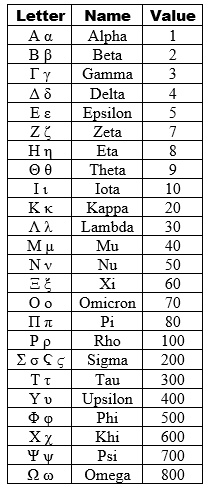
The more astute observer will likely have noticed that there are no letters in the Greek alphanumeric system to represent the numbers 6 or 90. This was not always the case. The original Greek alphabet contained three additional letters not charted in the figure above, which were later discarded by the ancient Greeks (who apparently decided that they had no use for them). Two of these were the letters digamma (which was positioned between epsilon and zeta), and the letter sampi (positioned between pi and rho). As one might imagine, when the Greek alphanumeric system was originally devised, the letter digamma represented the number 6, and the letter sampi represented the number 90.2 When these two letters were later dropped from the Greek alphabet, the Greeks did not bother to adjust the assigned numeric values of their alphanumeric system accordingly to make them more orderly and logical.
As previously stated, the Greek alphanumeric system predates the Hebrew one–albeit by exactly how much is anyone’s guess. The oldest surviving artifact which contains a clear and objective use of the ancient Greek alphanumeric system is a papyrus that dates to 311-310 BC.3 Based on this we can safely conclude that the Greek system had been devised by this time. It is not hard to imagine that the system had already been around for sometime before that, and was perhaps mainstreamed and popularized by Alexander the Great, who sought to unify his empire through the spread of Greek culture and customs.
The Hebrew alphanumerical system
The Hebrew alphanumeric system was developed after the Greek one, and it is widely believed that the Jews took their inspiration from the Greeks (whose customs and culture dominated the world in which they lived after Alexander the Great conquered the Holy Land in 331 BC) when they devised their system.4 The Hebrew system follows the exact same pattern and logic as the Greek one, albeit without random deviations due to discarded letters. The first ten letters represent numbers 1-10; the next nine letters represent values 20, 30, 40, 50, 60, 70, 80, 90 and 100; and the remaining three letters represent the values 200, 300, and 400:

God utilized these ancient alphanumerical systems to plant alphanumeric codes in the Bible.
Thus far we have learned that the Greek and Hebrew alphanumeric systems were each devised at different times during the intertestamental period. As previously mentioned, these systems arose out of the collective societal need for a standardized system of representing numbers in writing, and they were thus devised to be used to meet the every day practical needs that come with living in a civilized society. The key point I want to emphasize here is that these alphanumeric systems were not in any way shape or form consciously devised for the purposes of encrypting texts with coded messages, or for the purposes of mystical speculation. Ironically, just as it is believed that the Jews took their inspiration from the Greeks in devising the Hebrew alphanumerical system, so too many scholars contend that the Greeks borrowed the idea of using their alphanumeric system for the purposes of mystical speculation and textual exegesis from the Jews in late antiquity.5
Although the Hebrew and Greek alphanumeric systems were devised strictly for practical purposes, God in his perfect foreknowledge and infinite understanding (Job 36:4; 37:16; Ps. 147:5) utilized these alphanumeric systems while the biblical books were being written, revised, compiled, and formatted–in order to deliberately plant alphanumeric codes in the Bible. I believe that he created these codes to serve two primary purposes. On the one hand, I believe he designed these codes in order to establish and strengthen spiritual relationships between related biblical constructs. The other intended purpose I believe appertained to the watermarking and authenticating of the biblical text.
To demonstrate the way in which God used alphanumeric equivalencies to establish spiritual relationships between biblical constructs, let us consider a very simple example. Behold:

When we stop and reflect on it, the underlying spiritual logic binding these two constructs together should be fairly self-evident. The Bible declares in several places that the word of the LORD is the very first of the works of God–having existed from the very beginning (John 1:1; Rev. 3:14; 1 John 2:14; Prov. 8:23). What is more, the word of the LORD is frequently symbolized in the Bible by a candlestick (Zech. 4:2; 4:6). What God is trying to infer from this alphanumerical equivalency is that “the word of the LORD” is one and the same with the light that was spoken into existence on day 1 of Creation. This claim lines up with the entire collective body of Scripture (John 1:1-4; 1 John 1:1; Prov. 8:23).
Examples of Alphanumeric codes in the Bible
Alphanumeric codes in the Bible come in many different shapes and sizes. Underlying spiritual connections and relationships can be inferred from alphanumeric equivalencies occurring between single words, names, phrases, statements, and even entire verses.
Basic alphanumeric equivalencies
The most basic type of alphanumeric codes in the Bible are equivalencies occurring between single words or names.
Example
The following is a very basic example of an alphanumerical equivalency occurring between two names in the Old Testament, which is intended to infer an existing spiritual relationship between two otherwise seemingly unrelated biblical constructs:

As can be seen, the name “Joseph” as it is spelled in Hebrew carries a total gematrical value of 156 when all of its containing Hebrew letters are summed. The very same is true for the word “Zion” in Hebrew. What might be the relation between these two seemingly unrelated biblical constructs?
Zion is the name of a specific hill in Jerusalem that God has chosen to be his permanent divine residence (Ps. 132:13). Anything that God “chooses” is always hated by the world (John 15:19; 1 Cor. 1:28)–it’s just one of those eternal laws which governs the Universe. It thus follows that because Zion is God’s chosen dwelling place, Zion is hated by the world (Mic. 4:11; Ps. 129:5). Put another way, Zion is the place that God has chosen out of all of the tribes of Israel to “put his name there,” (Deut. 12:5; 12:21; 26:2; 1 Kings 11:36; 14:21; 2 Chron. 12:13; Ezra 6:12), and Zion is accordingly hated “for his name sake” (Isa. 66:5; cf. Matt. 24:9; Mark 13:13; Luke 21:17).
Like Zion, Joseph was from birth chosen by God. Out of all of his brothers, it was he who was chosen to be the deliverer of Israel and the entire world (Gen 45:4-13; 50:20). He was also divinely chosen out of all his brothers to be the one who would inherit the birthright promises (1 Chron. 5:2). Because he was divinely chosen, he was hated by his ten brothers (Gen. 37:4-11), who on a prophetic level in the Genesis narrative symbolize all the nations of the world. The underlying spiritual relationship between Joseph and Zion is very clear. Both were chosen by God, and as such–both were/are hated by the world. The alphanumeric equivalency between these two names in Hebrew bears witness of this spiritual relationship.
Alphanumerically equivalent phrases and sentences
It is not uncommon for alphanumeric codes in the Bible to manifest as phrases or sentences. Consider the following example:
Example

As can be seen, the phrase “seal the Law among my disciples” in Isaiah 8:16, carries a total gematrical value of precisely 1,151 when the numerical values of all of its containing Hebrew letters are summed. This just so happens to be the exact same total gematrical value of the phrase: “Zerubbabel, my servant, the son of Shealtiel” when the numerical values of all of its containing Hebrew letters are summed. Might this have been deliberately done by God to establish or affirm some kind of spiritual relationship? Indeed. In order to understand the relationship between these, we must first understand what a signet was, and what it meant to “seal” a document in antiquity.
In ancient times, every king owned a signet ring. A signet ring was a ring with a custom engraved emblem (known as a seal) on the front of it, which functioned as a mark of identity and a symbol of the ring owner’s authority. Any time the king would issue any kind of legislation or written correspondence, he would roll up the document, pour molten wax or clay on the top of it, and press the top part of his signet containing his seal into the molten wax or clay. Once the wax or clay cooled, it would harden–creating a hardened impression of the king’s seal. The king’s seal certified that the king was the author and issuer of the legislation or writing, and thus established that all laws contained therein were absolutely binding upon all subjects residing within his dominion.The signet ring, in other words, functioned as ancient man’s handwritten signature.6
Aside from functioning as a mark of identity and a symbol of personal authority, there were additional benefits to sealing written documents in old time. Once a document was sealed, it could not be opened and read without breaking the seal. Thus, sealing a piece of written correspondence was a means by which one could ensure that it was kept confidential. But even more than that, it was a way by which one could be certain that the text of a written document had not been tampered with or altered by a third party at any point during the process of transmission.
It is this latter function which enables us to fully understand the LORD’s commandment through the mouth of Isaiah in Isa. 8:16 to bind up the testimony and seal the law among his disciples. What he is inferring is that the Law (the Written Word of God) was to be rolled up and sealed with the LORD’s own signet, so that after all of the prophecies contained therein had been fulfilled in years to come–one could break the seal and open it and read and see for themselves that these were the true words of God.
Now you ask, how might the Hebrew phrase “seal the law among my disciples” in Isa. 8:16 be related to the numerically equivalent phrase “Zerubbabel, my servant, the son of Shealtiel” of Hag. 2:23? The answer to this question is revealed in the very verse from whence this cluster of words was taken:
In that day, saith the LORD of hosts, will I take thee, O Zerubbabel, my servant, the son of Shealtiel, saith the LORD, and will make thee as a signet: for I have chosen thee, saith the LORD of hosts. (Haggai 2:23)
As we can see, Haggai 2:23 is a prophecy addressed to Zerubbabel, in which the LORD declares that he will make him like his own signet, or seal.7 Thus it as if the numerically equivalent phrase “seal the law among my disciples” in Isaiah 8:16 functions on one level as a divinely encoded alphanumeric cryptographic allusion to the numerically equivalent phrase “Zerubbabel, my servant, the son of Shealtiel” of Hag. 2:23–as Zerubbabel was to become God’s signet (the ring which he would use to seal his Law). Because these two sets of words are so obviously topically related, we can be certain that the alphanumeric equivalency was done deliberately by an intelligent hand.
Alphanumerically equivalent whole verses
The most complex and most astounding type of alphanumeric code we find in the Bible are alphanumerically equivalent whole verses. The entire Bible is saturated with alphanumerically equivalent verses whose textual content is obviously topically related. One of the reasons that this is so astounding is that the modern system of verse divisions wasn’t added to the Bible until the fifteenth and sixteenth centuries. This is important for two reasons. First, it proves that no man or group of men could have consciously and deliberately planted these alphanumeric codes in the Bible—since all of the biblical books were written at least 1,000 years before the verse divisions were added to the Bible. Second, it proves that the modern system of verse divisions is just as divinely inspired as the actual text of the biblical books.
Example 1
Below is an example of two alphanumerically equivalent verses of the Greek New Testament, whose textual content is so obviously related that it is impossible to not have been deliberate:

The topical relation between these two verses is so obvious that it should need no explanation. Both passages speak of God raising someone from the dead. John 11:43 is recounting Jesus’ resurrecting Lazarus from the dead, while Hebrews 11:19 is speaking with reference to Abraham’s willingness to sacrifice his son Isaac–an evident token of the greatness of his faith.8 Given such obvious topical relation, it is undeniable that the alphanumeric equivalency between these two verses was done deliberately by an intelligent hand.
Example 2
The table below charts an alphanumeric code occurring between three whole New Testament verses whose topical relation is self-evident:

All three of the above verses carry a total gematrical value of exactly 10,319 when all of their containing Greek letters are summed. As can be seen, the textual content of all three of these alphanumerically equivalent verses speaks of the divine mandate to honor one’s earthly parents (Exod. 20:12; Deut. 5:16). Mark 7:10 and Matthew 15:4 record Jesus’ reiteration of the divine commandment to honor one’s father and mother, while John 19:26 records Jesus on the cross actually honoring his earthly mother–almost as if he is leading by example. Note that the verses in the top two rows are both slightly different records of the same statement made by Jesus. Yet what is remarkable is that Matthew and Mark word the statement quite differently.9 Despite this, they are both worded in such a way that both verses both end up having total gematrical value of precisely 10,319–which obviously is miraculous.10Obviously, the obvious topical relation occurring between these three alphanumerically equivalent verses is nothing short of miraculous, and is indicative of deliberate intelligent design.
What Such Alphanumeric Codes in the Bible reveal about the Bible’s System of Verse Divisions
As previously mentioned, the system of verse divisions found in modern Bibles today was not devised and added to the Bible until the fifteenth and sixteen centuries. The significance of this is that it completely rules out the possibility that the alphanumeric codes in the Bible involving whole verses could have been consciously and deliberately created by the biblical writers. I have constructed an extremely compressed timeline of events which should help one to better conceptualize this very important fact:

The fact that the modern system of verse divisions wasn’t added to the Bible until well over 1,000 years since the last book of the Bible was written, proves that whoever is responsible for such alphanumeric codes in the Bible which utilize the system of verse divisions is someone with perfect knowledge and foresight who is not bound by the laws of time and space.
Mixed-type alphanumerical equivalencies
There really are no limits to the use of gematria and isopsephy in biblical exegesis, as every letter of Scripture is divinely inspired and not even the tiniest letter is coincidental. Alphanumeric codes need not be as clean-cut as the examples we have surveyed thus far. Spiritually meaningful alphanumeric equivalencies can occur between a single word and a multi-worded statement, for example.
Example
The table below documents an alphanumeric equivalency occurring between the statement va’yiqra elohim la’or yom (“And God called the light Day”) in Genesis 1:5, and the word menorat (construct chain form of the word menorah) as it appears in the prophetic vision of Zechariah 4:2.11 Behold:

The spiritual relationship between the word and statement is multifaceted. Obviously, the statement: “And God called the light Day” (Gen. 1:5) speaks of God’s naming the light that he spoke into existence at the very beginning of Creation.
The candlestick of the Zechariah 4 vision is the same candlestick that Moses made for the tabernacle. As I have explained at length in another post, its seven lamps represent the seven days of Creation. So already we know that the menorah is directly tied to the seven days of creation, as I have already established in multiple previous posts.12
The golden candlestick is also a symbol of the Word of God (Zech. 4:6), which was the light that God commanded to shine out of the darkness on day 1 of Creation (2 Cor. 4:6). Thus the alphanumeric equivalency in this example affirms and reinforces this existing spiritual relation between the light created on Day 1, and the golden candlestick that appears in the vision of Zechariah 4. Both symbolize the Word of God, and both are linked to the seven days of Creation. This alphanumeric equivalency is not a coincidence.
Alphanumerical codes in the Bible which transcend the language & testament barrier
Thus far all of the examples of alphanumeric codes in the Bible that we have looked at have been ones confined to the same language and testament. Yet, because God is the author of the entire Bible, and because he is perfect in knowledge and infinite in his understanding–alphanumeric codes in the Bible very often involve material from different testaments.
Example 1
The following is an example of a mixed-type alphanumeric code involving entities from two different testaments:
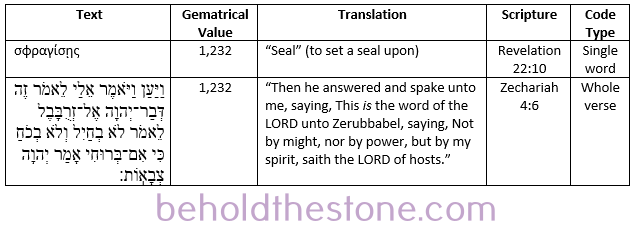
As the table above demonstrates, the ancient Greek verb for “seal” as it appears in Revelation 22:10 contains a total gematrical value of 1,232 when all of its containing Greek letters are summed. This is the exact same total gematrical value of Zechariah 4:6 when all of the Hebrew letters contained in that verse are summed. At the time that the prophetic vision of Zechariah 4 was delivered, the LORD had just promised Zerubbabel through the prophet Haggai a couple of months prior that he would make him like his own signet ring (Hag. 2:23). Because of the obvious topical relation between the biblical character of Zerubbabel and the biblical construct of the seal, we can be fairly certain that this is a divine fingerprint rather than a coincidence.
Example 2
The table below charts an alphanumeric code of the whole verse variety which transcends the language and testament barrier. Behold:
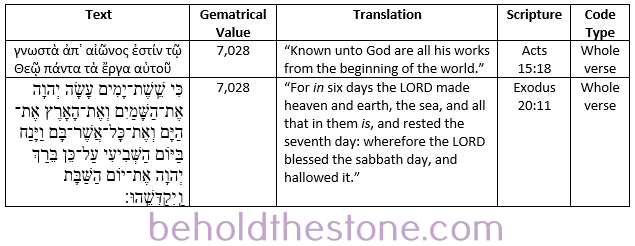
As we can see, Acts 15:18 contains a total gematrical value of precisely 7,028 when all of its containing Greek letters are summed. This just so happens to be the exact same total gematrical value of Exodus 20:11 when all of its containing Hebrew letters are summed. Because it is blatantly obvious and undeniable that these two alphanumerically equivalent verses are topically related, it is obvious that this was done deliberately by an intelligent hand.
Why God planted alphanumeric codes in the Bible
As we have already noted, one reason that God planted alphanumeric codes in the Bible was for the purpose of establishing and strengthening spiritual relationships between related biblical constructs and biblical passages. In so doing, he has provided the student of Scripture with an additional interpretative layer through which he can communicate revelation. Yet, this is far from the only reason. The other, perhaps more fundamental reason that he utilized the ancient Greek and Hebrew alphanumerical systems to deliberately plant alphanumeric codes in the Bible, was that it provided him with yet another means by which he could watermark the biblical texts to affirm their authenticity.
In his perfect foreknowledge, the Lord foresaw that men in the last days would become lifted up with pride as their knowledge continually multiplied (Dan. 12:4; 1 Tim. 4:1), and he knew that this would inevitably lead to an epidemic of spiritual blindness that would cause them to doubt and reject the divine inspiration of his Word. Accordingly, he used a wide array of watermarking tools and methods during the roughly 3,000 years that the completed biblical canon was in the process of being developed. Utilizing the ancient Hebrew and Greek alphanumeric systems to plant alphanumeric codes in the Bible was just one of the many “watermarking” methods that he used to accomplish this feat.
Conclusion
The presence of alphanumeric codes in the Bible is not coincidental. These patterns serve as divine fingerprints, demonstrating that Scripture was meticulously designed by a being beyond time and human limitation. Far from being a mere collection of ancient writings, the Bible contains undeniable evidence of its supernatural origins. Through alphanumeric analysis, we gain not only deeper insights into biblical truth but also a renewed appreciation for the intricate ways in which God has stamped His divine signature upon His Word.
© 2021 – 2025, Zerubbabel. All rights reserved.
 Copyright secured by Digiprove © 2021 Zerubbabel
- Georges Ifrah, “Greek Alphabetic Numerals,” in From One to Zero: a Universal History of Numbers, trans. Lowell Bair (New York, NY: Penguin, 1988), pp. 267.
- Ifrah, 261.
- Ifrah, 267.
- Ifrah, 270.
- Irfah, 300.
- As a matter of fact, the modern Hebrew verb לחתום (“to sign“), is the ancient Hebrew verb “to seal.” The word is the same, only the meaning has changed.
- The Hebrew word for “signet” and “seal” in Hebrew were (and still are) the same word.
- The implication is that Abraham’s faith in the word of the LORD was so great that he knew that God would be bound by his own Word to resurrect Isaac if Abraham sacrificed him–since he had already promised Abraham: “in Isaac shall thy seed be called.” (Gen. 21:12; cf. Heb. 11:18).
- As a matter of fact, because ancient Greek was such a highly inflected language, the statements are even more different in Greek than they appear in English translation!
- Indeed, it is even more miraculous when we remember that the modern system of verse divisions wasn’t added to the Bible until the fifteenth and sixteenth centuries. This of course proves that the hand responsible for such alphanumeric codes occurring between whole verses is someone who is not bound by the laws of time and space.
- The noun menorah (“candlestick“) in Zechariah 4:2 appears as part of a construct chain, causing it to decline (possess an altered spelling) in this verse. Normally, the word menorah in Hebrew has a total gematrical value of 301. However, in the altered form in which it appears in Zechariah 4:2, the word yields a total gematrical value of 696. This is a result of a Hebrew grammatical rule whereby if the first word of a construct chain is feminine and ends with the letter hay, the hay changes to a tav.
- In a previous post, I revealed that the seven days of Creation are patterned after the golden candlestick as described in Exodus 25:31-40. Likewise in another post I revealed a hidden Bible code in Exodus 20:11, which affirms and reinforces this link between the golden candlestick and the seven days of Creation.
