Every so often, I will make a Bible code discovery that will stop me in my tracks. Such was the nature of the discovery I made just a couple of days ago. In the early morning hours of August 8, 2025, I ran a routine search that led to one such moment — a moment where the encoded text and the historical reality it pointed to were so perfectly aligned that I knew immediately that it was not a coincidence.
The name I searched for belongs to the man most associated with the September 11, 2001 terrorist attacks–Mohamed Atta. To fully appreciate the magnitude of what I will refer to as the Mohamed Atta Bible code, it is worth first recalling exactly who this individual was and what he is remembered for.
Who was Mohamed Atta?

Mohamed Atta (Arabic: محمد عطا, Moḥamed Mohamed al-Amīr ʿAṭṭā) was an Egyptian national and the operational leader of the September 11, 2001 terrorist attacks against the United States. Born on September 1, 1968, in Kafr el-Sheikh, Egypt, Atta studied architecture at Cairo University before moving to Germany in 1992 to pursue graduate studies at the Technical University of Hamburg-Harburg.
While living in Germany, Atta became involved with a radical Islamic network, eventually joining al-Qaeda. By the late 1990s, he had been chosen to lead the so-called “Hamburg Cell,” a group of operatives tasked with carrying out a large-scale attack on American soil.

On the morning of September 11, 2001, Atta served as the pilot of American Airlines Flight 11, the first of four hijacked aircraft. He and four other hijackers boarded the flight at Boston’s Logan International Airport and seized control shortly after takeoff. At 8:46 a.m., Atta deliberately flew Flight 11 into the North Tower of the World Trade Center in New York City, striking between the 93rd and 99th floors. The impact and resulting fires ultimately caused the tower’s collapse at 10:28 a.m., killing thousands of people.
Atta’s actions made him the most infamous of the nineteen hijackers, and his name has become synonymous with the planning and execution of the September 11 attacks.
Mohamed Atta in the Bible code
In the early morning hours of August 8, 2025, I fired up my Bible code search software — something I often do before beginning work on my blog — and began running a few random ELS (Equidistant Letter Sequence) searches.
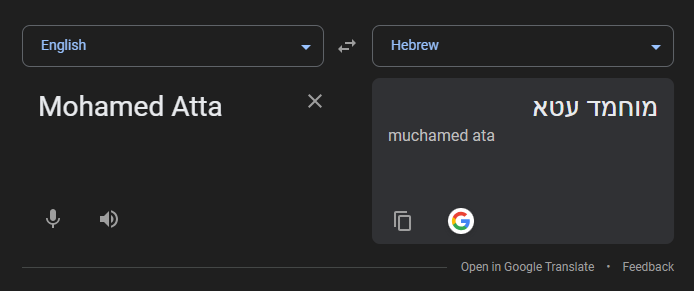
At some point, I decided to search for the name Mohamed Atta (מוחמד עטא in Hebrew). Since Bible code searches ignore spaces, I entered his name as a single unbroken string (מוחמדעטא). I conducted the search using the Westminster Leningrad Codex as my base text, with the ELS range set between 1 and 150,000 letter skips.
After about 30 seconds, the search completed — returning only one hit in the entire Hebrew Bible. That lone occurrence appeared at an ELS of 33,207. The following screenshot reveals what the code looks like on the grid generated by the computer:

When I clicked on the result and began to examine the grid, one of the verses that intersected with the encoded name immediately caught my attention: Judges 9:51.
As I began to read, I felt a chill go up my spine:
But there was a strong tower within the city, and thither fled all the men and women, and all they of the city, and shut it to them, and gat them up to the top of the tower. And Abimelech came unto the tower, and fought against it, and went hard unto the entrance of the tower to burn it with fire. (Judges 9:51-52)
This is not merely imagery loosely reminiscent of September 11 — it is a direct prophetic description of the very act for which Mohamed Atta is historically known:
- “Strong tower within the city” → evokes the North Tower of the World Trade Center in Lower Manhattan.
- Men and women go to the tower and ascend to its top → just as thousands of employees went to work in the North Tower that morning, many to offices on the upper floors.
- Attacker arrives with intent to burn it with fire → exactly what happened when Atta flew American Airlines Flight 11 into the North Tower at 8:46 a.m., igniting massive jet-fuel fires.
The sequence is precise and chronological — the people are already at the top of the tower before the attacker arrives, just as they were on the morning of 9/11.
It is also worth noting how the situation described in Judges 9:51–52 prophetically aligns with the attack on the North Tower — the tower that Atta’s plane struck — in particular. In the North Tower, the impact of Flight 11 severed and destroyed all staircases between the 92nd and 99th floors, instantly cutting off escape for those above the impact zone. As a result, hundreds of men and women were trapped at the very top of the building — precisely matching the picture in Judges 9:51 of the city’s inhabitants ascending to the top of the tower. This also explains why the majority of those who jumped on 9/11 came from the North Tower.
By contrast, the attack on the South Tower struck lower, closer to the middle of the building, and at an angle that left one staircase intact — allowing some above the impact zone who were fortunate enough to find it a way to escape.
Statistical Significance of the Discovery
One of the most important tests in Bible code research is frequency of occurrence. In this case, the Hebrew spelling of Mohamed Atta (מוחמדעטא) — entered as a single unbroken string — was found only once in the entire Westminster Leningrad Codex when searched within an ELS range of 1 to 150,000 letter skips.1
Under a conservative statistical model that assumes all Hebrew letters occur with equal frequency, it is not uncommon to find an eight-letter string encoded somewhere in the Hebrew Bible—particularly when extremely large ELS skip ranges are permitted. The problem is, Hebrew letters do not occur in the Bible with equal frequency.
In the case of Mohamed Atta’s name as written in Hebrew (מוחמדעטא), we are dealing with a string that includes a ט (tet)—one of the rarest letters in the Hebrew Bible, appearing in only 1.24% of all letters. It also contains two other letters—ח (chet) and ד (dalet)—each of which appears only about 2.5% of the time. The inclusion of these rarer letters significantly reduces the likelihood of the full name appearing by chance.
Incorporating actual frequency data, and considering roughly 99.75 billion possible ELS paths between skips 1 and 150,000, the expected number of random occurrences for this specific eight-letter sequence is about 1.22—yielding a 70.5% probability that the name Mohamed Atta appears at least once by random chance. Thus, discovering Mohamed Atta’s name encoded one time in any given edition of the Hebrew Bible (when searched with such a high skip limit) is not by itself statistically improbable.
What is not plausible is that this lone occurrence appears on a grid where the encoded name intersects a passage that perfectly describes the legacy of that individual. When the encoded name converges with topically relevant plain text on the grid to form a coherent message that directly aligns with the historical actions of the named person—the probability of coincidence collapses. This is no longer a literary curiosity or accidental pattern; it is the signature of God upon the biblical text—bearing witness to the Bible’s divine authorship and supernatural foresight.
Conclusion: Mohamed Atta Encoded in the Hebrew Bible in a Passage Foretelling the North Tower Attack
The fact that the name Mohamed Atta is encoded only one single time in the Hebrew Bible (Leningrad Codex), and just so happens to intersect with a passage in Judges 9:51–52 that prophetically describes the very act for which Mohamed Atta is infamous — is not the product of chance. The narrative correspondence is exact–even the sequence of events described in the passage is in perfect alignment with Atta’s attack on the North Tower on September 11, 2001.
This is not merely a poetic image or a curious coincidence. The code names the attacker, identifies the nature of his attack, and situates it in a context that mirrors the historical event with chilling precision. It reads as a prophetic declaration, deliberately embedded in the Hebrew Bible thousands of years before the events of September 11, 2001 unfolded.
Whether one sees this as the work of divine design or chooses another explanation, the data speaks for itself: the biblical text contains information that could not have been placed there by human foresight. This discovery stands as yet another infallible witness to the supernatural authorship and prophetic depth of the Word of God.
- I ran the same search using two other versions of the Hebrew Bible as my base text — an edition that my Bible code software identifies as the Thenach Standard Text, as well as the Keter Jerusalem edition. The name מוחמדעטא does not appear at all in the Thenach Standard Text, but the search on the Keter Jerusalem edition returned two positive hits. Notably, in one of these Keter Jerusalem encodings, his name intersects with Ezekiel 32:29 — a verse in the midst of a passage in which God (through Ezekiel) speaks of those who once caused terror in the land of the living, but who have now been brought down to the pit, lying slain with their iniquity upon their bones among the uncircumcised. It is therefore possible that one or both of these additional encodings in the Keter Jerusalem edition are likewise deliberate and of divine origin. ↩︎
© 2025, Zerubbabel. All rights reserved.