

Introduction
For Christians seeking proof of the messianic identity of Jesus in the pages of the Old Testament, Isaiah 53 is the Mecca of all prophecies. This chapter so plainly describes the rejection and crucifixion of Jesus Christ that one is left bewildered trying to figure out how observant Jews could read these twelve verses and not conclude that it is talking about Jesus.1 The fact that anyone is able to read these same prophecies and arrive at an entirely different conclusion about the identity of God’s mysterious “servant”, inevitably forces us to ask–are the prophecies of Isaiah 53 really as objective as they seem, or have we just been conditioned as Christians to anachronistically inject Jesus into a prophecy that isn’t really about him? Today I am going to demolish such uncertainties and objectively prove that these prophecies are about Jesus. The wrecking ball with which I will accomplish this feat is the Bible code of Isaiah 53.
What are ELS Codes?
The Bible code of Isaiah 53 is what is known as an ELS code. ELS is an acronym that stands for Equidistant Letter Sequencing.
The basic idea of ELS Bible codes is that the Hebrew text of the Tanakh (what Christians call the Old Testament) contains divinely encoded words, phrases, and statements encrypted within the Hebrew Bible (Old Testament) at equidistant letter sequences. The idea is that these encoded messages either occur in topically relevant biblical passages, or converge with lines of topical correspondence on the grid, to form unified coherent messages or prophecies which breathe new life into the surrounding text. Code researchers seek to uncover these codes by using a special computer program to conduct ELS letter skip searches on the Hebrew Bible.
Demonstrative Example of an ELS Bible code
To help paint a clearer picture of the phenomenon just described, let us consider a very simple example. Behold:

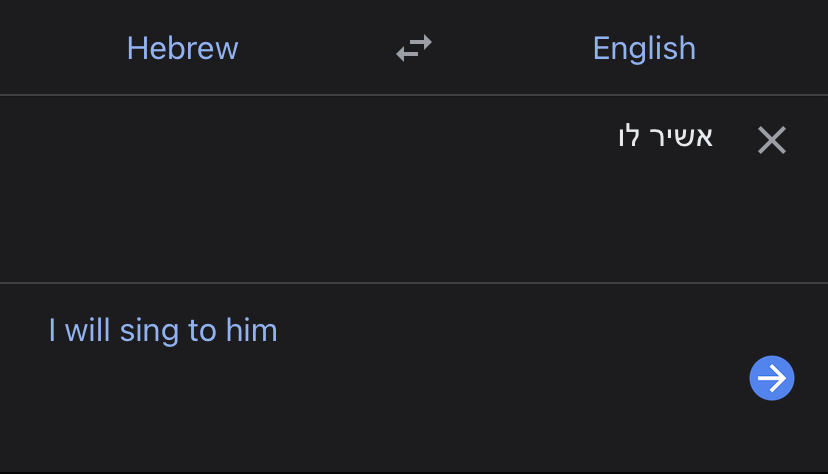
The table above documents Psalm 69:30 (Psalm 69:31 in Christian Bibles). The original Hebrew text is supplied in the right column, while the English translation is supplied in the left column. As indicated by the highlighted green letters of the verse in Hebrew, if you start at the very first letter of the verse and skip every five letters–you’ll find that every 5th letter spells out אשיר לו (pronounced: ashir lo), which translated to English means: “I will sing to him.“ The fact that this hidden statement appears in a verse which contains such blatantly obvious topical relation (e.g. “I will sing to him” in a verse talking about praising the name of God with a song) tells us that this did not occur by random chance.
The basic idea of ELS codes is that the entire biblical text is saturated with encoded words and phrases which converge to form meaningful cryptic prophecies or supplemental information that often breathe new life into the surface level narrative of the passage in which the words are encoded.2 For those who believe that biblical ELS codes exist, it is thus as if the Bible has two independent yet complimentary narratives–one on the surface which is visible, and one hidden beneath the surface which is invisible.3
History of ELS Bible codes
The first person that we know of to speak of what we now refer to as ELS codes within the Bible was a medieval Jewish rabbi by the name of Rabbeynu Bachayah (1255 – 1340 CE). In a commentary on the Torah written in the year 1291, Bachayah mentioned in a footnote on Genesis 1 that if you begin at the first letter of Genesis 1 and count 42 letters four times (making note of every 42nd letter), you will find the word בּהרד encoded within the text. He argued that this word had been deliberately encoded at the beginning of Genesis 1 by God, who was using it to establish a connection between the birth of the moon and the birth of the world.
Despite Bachayah’s promising finding, his observation largely went unnoticed, and ELS Bible code research would lay dormant for several centuries. Then, over 600 years later, a twentieth century Jewish Rabbi by the name of Michael Dov Weissmandl happened to learn of the phenomenon while reading Bachayah’s commentary on Genesis. The notion of ELS codes in the Torah aroused Weissmandl’s interest and curiosity enough to conduct his own experiments. These labors resulted in him finding the Hebrew word תּורה (“Torah”) encoded at 50 letter interval skips at the very beginning of the book of Genesis. It is largely Weissmandl’s experiments which would first spark modern interest in the idea of Bible codes of the ELS variety, and his findings basically fueled all subsequent ELS Bible code research that would follow after the advent of computers.
Religious rejection of ELS Bible codes
In making the claim that ELS Bible codes are real, I am at odds with a sizable portion of the Christian and Evangelical communities–many of whom reject the existence of such codes on the grounds that God does not speak cryptically or in riddles, and some of whom go as far as to claim that looking for codes in the Bible is a form of divination, which the Bible strictly forbids (Deut. 18:9-14).4These objections are ridiculous and cannot be defended biblically. Firstly, the Bible does in fact state that God speaks cryptically and in riddles (Psalm 49:4), so I don’t know what authority such Christian ministers are basing their idea that God does not reveal truths cryptically on–but it certainly is not the Word of God. Secondly, searching the Bible for divinely encoded messages only falls under the umbrella of divination if one’s intent in finding such codes is rooted in a vain attempt to foretell the future for their own personal gain.5
The Bible gives us a very simple test for determining whether or not a thing be of God. If it testifies that Jesus Christ is come in the flesh, it is of God; if it doesn’t testify that Jesus Christ is come in the flesh, then it is not of God (1 John 4:1-3). As we are about to see, the Bible code of Isaiah 53 (an ELS code contained within the Hebrew text of Isaiah 53) testifies of the messianic identity of Jesus Christ, and is therefore its own witness that it is of God.
The Bible code of Isaiah 53 revealed
As the Bible code of Isaiah 53 is directly relevant to the passages of Scripture in which it is encrypted, I feel like it would be a good idea to begin by taking a look at the full text of this chapter, just so that we are clear about the precise nature of the subject matter of the material in which the code is contained. Below is the full chapter of Isaiah 53 as it appears in the KJV:
Who hath believed our report? and to whom is the arm of the LORD revealed? For he shall grow up before him as a tender plant, and as a root out of a dry ground: he hath no form nor comeliness; and when we shall see him, there is no beauty that we should desire him. He is despised and rejected of men; a man of sorrows, and acquainted with grief: and we hid as it were our faces from him; he was despised, and we esteemed him not. Surely he hath borne our griefs, and carried our sorrows: yet we did esteem him stricken, smitten of God, and afflicted. But he was wounded for our transgressions, he was bruised for our iniquities: the chastisement of our peace was upon him; and with his stripes we are healed. All we like sheep have gone astray; we have turned every one to his own way; and the LORD hath laid on him the iniquity of us all. He was oppressed, and he was afflicted, yet he opened not his mouth: he is brought as a lamb to the slaughter, and as a sheep before her shearers is dumb, so he openeth not his mouth. He was taken from prison and from judgment: and who shall declare his generation? for he was cut off out of the land of the living: for the transgression of my people was he stricken. And he made his grave with the wicked, and with the rich in his death; because he had done no violence, neither was any deceit in his mouth. Yet it pleased the LORD to bruise him; he hath put him to grief: when thou shalt make his soul an offering for sin, he shall see his seed, he shall prolong his days, and the pleasure of the LORD shall prosper in his hand. He shall see of the travail of his soul, and shall be satisfied: by his knowledge shall my righteous servant justify many; for he shall bear their iniquities. Therefore will I divide him a portion with the great, and he shall divide the spoil with the strong; because he hath poured out his soul unto death: and he was numbered with the transgressors; and he bare the sin of many, and made intercession for the transgressors. (Isaiah 53:1-12)
Written sometime between about 740 – 700 BC, Isaiah 53 is hands down probably the most blatantly obvious Old Testament prophecy describing the rejection and crucifixion of Jesus Christ.
As can clearly be seen, Isaiah 53 is saturated with prophecies which are obviously about Jesus Christ, to the point that it is difficult to conceive of how one could possibly read the above chapter and arrive at any other conclusion. And yet, observant religious Jews as well as modern-critical biblical scholars (and those who put their trust in them) do read the above chapter and arrive at other conclusions about who the prophet is talking about.
Let us be very clear that it is not God’s will for anyone to be in doubt about who it is that the prophet is speaking of in this chapter (Acts 8:26-35). He therefore left not himself without witness (Acts 14:17; cf. Isa. 48:3-8; John 13:19; 14:29), and placed multiple ELS codes in this chapter in which he reveals himself as the subject of the prophecy. Behold the Bible code of Isaiah 53:

The Bible code of Isaiah 53 explained
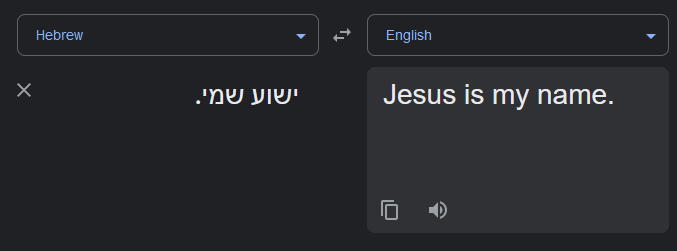
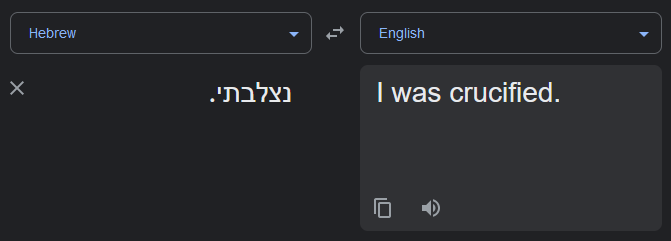
As can be seen, the Hebrew statements ישוע שמי (“Jesus is my name”) and נצלבתי (“I was crucified”) are both encoded in Isaiah 53:8-54:1 at different equidistant letter sequences. The statement Yeshua shmi, (meaning: “Jesus is my name”) is encoded at an ELS of every 20 letters backwards beginning at the second yod in the word יִארִיךְ (rendered “prolonged” in the KJV) in verse 10.6 The second statement is found at an ELS of every 52 letters beginning at the final nun of the first word of verse 9. This is the Bible code of Isaiah 53.7
For those who would try to argue that this is just a random statistical anomaly, I would add that this is the only passage in the entire Hebrew Bible where these two phrases are found encoded together in the same passage. This exclusivity in tandem with the thematic and topical relevance of the containing passage suggests that a random chance occurrence is highly unlikely.
Final thoughts on the Bible Code of Isaiah 53
It is common for the skeptics of Bible codes to try and argue that when you repeatedly skip a set number of letters in a huge text like the Bible, it is practically inevitable that clusters of letters are going to occasionally come together to form meaningful words in accordance with the laws of probability and statistics. While it is true that ELS searches can and do occasionally turn up words and phrases just by random chance, it is another thing entirely when you have coherent first-person statements occurring in prophetically and topically relevant biblical passages, which converge to form coherent unified prophecies or statements at statistically minuscule probabilities. The authenticity of such codes is irrefutable, as such codes are indicative of deliberate intelligent design.
In the case of the Bible code of Isaiah 53, we have the statements “Jesus is my name” and “I was crucified” both encoded in the most blatantly obvious description of the rejection and sacrificial death of Jesus Christ in the entire Old Testament. By encoding these two prophetically meaningful first-person statements in this specific chapter (and only this chapter), Jesus is not only affirming his messianic identity by identifying himself as the subject of the chapter’s prophecies, but he is also identifying himself as the spirit of prophecy speaking through Isaiah, as well as the author of the ELS codes hidden within these prophecies.
© 2020 – 2025, Zerubbabel. All rights reserved.
 Copyright secured by Digiprove © 2021 Zerubbabel
- The standard Jewish interpretation of this chapter is that the person the prophet is describing is a personification of the nation of Israel. As I demonstrate in another post, this interpretation actually isn’t wrong–as Moses in the Torah identifies Jesus an embodied personification of the entire nation of Israel (Numbers 2). What this means is that the Jewish and Christian interpretations of the prophecy are (ironically) both correct, as this scriptural metaphor enables Isaiah to speak of both Israel the nation and Jesus Christ the person simultaneously.
- This History Channel documentary does a really good job of explaining how the ELS codes function within the Bible.
- To give an analogy, we might liken the Bible unto an ocean–where the surface level narrative corresponds to the surface of the water, while the invisible narrative of codes corresponds to the invisible undercurrents of the vast sea of Scripture.
- As one example, Don Stewart makes both of these claims in his essay “Is There a Secret Code in Scripture That Proves Its Divine Authority? (The Bible Code)“
- Whether or not the practice of searching for codes in the Bible constitutes divination is dependent upon the intent of the code researcher. For example, if someone was to scour the Bible for codes in an attempt to find out who will win the NBA Finals next year so that they might place a big fat financial bet on the outcome, then that is a case in which looking for Bible codes would absolutely constitute the sinful practice of divination. However, it is important to note that biblical ELS codes are not even designed in a way that would allow for the accurate foretelling of future events. As with prophecies on the surface of the biblical narrative, they are designed in such a way that their true meaning and fulfillment cannot be identified until after the fulfillment has been brought to pass. They are, in other words, designed to function as a witness–not as fortune telling tools.
- When you begin there and count backwards at twenty letter interval skips a total of six times (making careful note of every 20th letter), you will find that every twentieth letter spells out ישוע שמי, which literally translates into English as: “Jesus is my name.”
- To see the full code matrix as it actually appears in the grid, click here.


Thank you for your work in the Word. It’s a blessing to all who take to follow your work.
is the phrase”gushhing rom above, jesus was my mighty name, and the clouds rejoiced-” found at isaiah 53 at els 20-please answer in hebrew letters-please answer in debth to this query…
Negative. There are letters surrounding the encoded phrase ישוע שמי (“Jesus is my name”) on both sides (at the ELS skip of 20) in the matrix, which form real Hebrew words if spacing is inserted in the right places. The question is whether these are part of the encoded text-string or are merely coincidental. Typically it is fairly easy to infer this based on whether the string of words forms a coherent statement that is also relevant to the passage in which it is found, or if they form incoherent babble.
Here is the longer text-string from Isaiah 53 which includes these extra letters:
קםעלישועשמיעז
Now here is what the text-string looks like when we insert spacing where necessary to form Hebrew words:
קם על ישוע שמי עז
Here is what these words mean when broken down:
קם : “arises” or “arose” (tense must be inferred here because the Bible codes utilize a strictly consonantal text)
על : “upon” or “on”
ישוע : “Yeshua” (Jesus)
שמי : “My name”
עז : “strong”, “mighty”, “fierce”, or “power”
Taken together, it is possible that the phrase “Jesus is my name” is part of a larger encoded text-string which (when modern English syntax is applied) would read something like: “My mighty name arises/arose upon Jesus.” In this case, it is difficult to tell if this is the entire intended encryption, or if it is just a coincidence. It could be argued that the statement is meaningful, but it also sounds kind of funny. My personal opinion is that “Jesus is my name“, or “Jesus is my mighty name” is the entire deliberate encryption.
Hope this helps.
Hi Shalom!
Very good discernment! I can scientifically confirm your findings that I found independently this last week before finding this web site (and your comments), but you missed a word that precedes them all to make this a sentence complete:
שק Sack[cloth]
-20 שק Sack[cloth], i.e. ancient visible sign of mourning the dead.
-20 קם Arises
-20 על Upon / Over / About
-20 ישוע Yeshua
-20 שמי [is] my name
In these days I am completing a scientific research paper on this very subject.
I invite you to follow along on our GitHub repo.
TorahBibleCodes.com
GitHub.com/TorahBibleCodes
Daniel Azariah
DanielAzariah.com
AzariahBible.com
Reading your comments again, indeed “might/strong” is another part of the sentence:
-20 שק Sack[cloth]
-20 קם Arises
-20 על Upon / Over / About
-20 ישוע Yeshua
-20 שמי [is] my name
-20 עז [[is] my ] STRONG [name]
52 נצלבתי [I] was crucified
You can download 2D Matrices for each book of the Hebrew Bible at the following TorahBibleCodes project, and anyone can search visually for themselves.
https://github.com/TorahBibleCodes/TorahBibleCodes/tree/master/2DMatrix_2DMatrices_4BooksOfHebrewBible_ELS_TorahBibleCodes
I’m learning Hebrew so I can’t really read this without vowels yet.
Reading your comments again, indeed “might/strong” is another part of the sentence, but the comment system here won’t let me post a copy of my above comment with the following added:
-20 עז [[is] my ] STRONG [name]
52 נצלבתי [I] was crucified
From the picture, I read “ימשעושי”; so, the letters seem to be mixed up. Is that normal for ESL codes? And if so, is it not easily falsifiable?
(Or is there something wrong with the picture? I didn’t have the time to check this in my own Bible yet.)
Sorry! I read from top to bottom (as I’d normally read). I should have started with the last letter. It’s early in the morning here. 🤓
Just published academic paper which includes link to all research data of ELS Codes found:
TorahBibleCodes: Free, Open-Source Python Equidistant Letter Sequences (ELS) Hebrew Bible Search Software (PREPRINT JULY 2023 OF FORTHCOMING
https://www.academia.edu/104334275/TorahBibleCodes_Free_Open_Source_Python_Equidistant_Letter_Sequences_ELS_Hebrew_Bible_Search_Software_PREPRINT_JULY_2023_OF_FORTHCOMING_
Read this over and over again!
It leaves me with more questions than answers.
Are there codes in the NT as well?
Why didn’t Jesus, the Apostles or the early church ever speak of these codes?
Non messianic Jews discovered these and we should trust them why?
What’s the difference between these codes and the ones Muslims claim they have found in the Quran?
And lastly Isn’t your defence to objections based on one verse of one Psalm only?
Didn’t God speak clearly and spoke in parables (through Jesus) so that only those believing in him would understand?
Hello Chris. I apologize that it has taken me so long to respond to this–I vaguely remember seeing this comment when you first posted it, but I obviously forgot to respond. Better late than never. I am going to address each of your questions one at a time.
1. “Are there codes in the NT as well?”
Good question–I cannot say one way or the other, simply because I don’t possess software that is capable of conducting equidistant letter skip searches on the Greek New Testament. It is certainly possible, although I will say that Hebrew is much more naturally suited for this particular type of encryption. Ancient Greek is a highly inflected language whereas Hebrew has a number of grammatical features which make it possible to say a lot with fewer letters. Regardless, with God all things are possible (Matt. 19:26; Mark 10:27; Mark 14:36; Luke 1:37).
2.) Why didn’t Jesus, the Apostles or the early church ever speak of these codes?
First, the Apostles and early church would not have even been aware that such codes existed. They were human beings just like you and I are, imperfect in knowledge and bound by the time in which they lived. What is more, they did not possess the technology required to uncover such hidden messages. These codes were obviously intended to be discovered after the invention of the computer.
As for Jesus, the real question is why WOULD he have spoken of them? First of all, although he was God (who is all knowing)–he submitted himself to the limitations of human nature when he indwelt his mortal human body. That means that in his human nature–he would not have had any knowledge of Bible codes. Any time you see Jesus in the Gospels possessing knowledge of things about people that no human being could have possibly known (as with the Samaritan woman in John’s Gospel), or of things afar off in the future–he was accessing that information in real time through the Spirit, as it was actively being revealed to him. That knowledge, in other words, was not coming from his human brain–but was being downloaded into him actively in real time.
In addition to that, Bible codes weren’t relevant to his mission or message, and there was no reason for him to speak of them in the first place. The entire subject would not have even been relevant to his generation–as no one living at that time doubted the authenticity or divine authorship of the Hebrew Scriptures. Bible codes were created to be uncovered in the last days after the invention of the computer–to be found by the information-age generation, whom God in his perfect foreknowledge foresaw would doubt the divine inspiration and authenticity of his Word (Josh 24:26-27; Hag. 2:21-23; Dan. 12:4; Rev. 11:7-13; Prov. 30:11-13).
3.) “Non-messianic Jews discovered these. And we should trust them why?”
Okay, rabbinic unbelieving Jews also preserved the Hebrew text of the Old Testament. Does that stop you from reading English Bibles based on the Masoretic text which was preserved by Jews? If it were the case that God cannot use non-messianic Jews to preserve his Word, then that would mean that the integrity of the entire Christian Bible is compromised and cannot be trusted, which in turn would mean that your faith is in vain.
Secondly, Rabbinic Jews are the first to have discovered ELS codes in the Hebrew Bible. And that’s because very few people in the world speak and understand Hebrew, and 99.9% of those who do speak and understand happen to be rabbinic Jews (very few Christians know Hebrew). Thus, most Bible code proponents are Jews–since they are more or less the only people on planet Earth capable of researching this subject. And while they are the first to have discovered ELS codes in the Bible, they have not discovered any ELS codes about Jesus like the one published in this article. All of the codes that I share on this blog are my own original discoveries (unless otherwise stated) that I have uncovered in my own personal research.
So what you have is a situation whereby Jews discovered ELS codes in the Bible, but they are ignorant of the personal identity of the individual who is responsible for the codes. And the reason that they are ignorant of the encoder’s identity is not because the encoder doesn’t reveal his identity in the codes, but rather because Jewish code researchers tend to not be looking for him, as Jesus is not a person of relevance in the mind of most Jews. This is a fulfillment of God’s prophetic declaration through Ezekiel that he would not be enquired of by his own people (Ezekiel 20:3; 20:31). In other words, they do not find him in the Bible codes because they don’t enquire of him. If they searched for him they would surely find him (Jer. 29:13; Prov. 8:17), and if they called he would surely answer (Jer. 33:3).
4.) “What’s the difference between these codes and the ones Muslims claim that they have found in the Quran?”
I am not aware of any ELS codes found in the Quran, nor have I ever seen any published literature about such codes being found in the Quran. Regardless, I can guarantee you that they haven’t found any statistically significant codes whose intelligent design is irrefutable and self-evident like the ones I have found in the Hebrew Bible though. The Quran isn’t even remotely comparable to the Bible.
5.) “Isn’t your defense to objections based on one verse of one Psalm only?”
I don’t need more than one verse when citing the Bible, as it functions as one unified body of writings which are connected and brought to life by the same Spirit (Eph. 4:4). However, if you would like other verses which support the point I was making there: Prov. 25:2; Deut. 29:29; Isa. 45:3; Isa. 48:3-8.
6.) “Didn’t God speak clearly and spoke in parables (through Jesus) so that only those believing in him would understand?”
Not sure I follow what you are attempting to argue here. If anything, the fact that Jesus spoke in parables would only lend support to my claim that he communicates truth cryptically.
Hope this helps.
-Zerubbabel
It does not say Jesus because there is no J in Hebrew. There must be some kind of disconnect, He says YESHUA is my name and you still call him Jesus. If I tell you my name is Bill will you call me Jeff, I hope not. His name has meaning it means YAH SAVES or YAHS salvation. Jesus has no meaning in any language. Hope this helps
I’m well aware there is no “J” in Hebrew—Hebrew and English have very different phonetic systems. The name “Yeshua” is the Hebrew/Aramaic form, which transliterates into Greek as Ἰησοῦς (Iēsous) and from Greek into English as “Jesus.” This isn’t a case of two unrelated names (like Bill vs. Jeff), but the same name expressed in different languages.
It’s normal for names to take different forms across languages. For example, “John” in English is “Juan” in Spanish, “Giovanni” in Italian, and “Jean” in French—but it’s the same name. I use the English form because English is both my native language and the global lingua franca, and most of my readers speak it. The Church is made up of believers “from every nation under heaven” (Rev. 5:9; Acts 10:35), and Christians around the world pronounce His name according to their own tongue.
The power of His name does not lie in its phonetic form—as though it were a magic incantation—but in the Person to whom it refers. If He only recognized the Hebrew pronunciation, He would not have commissioned the New Testament to be written in Greek, where His name is always written as Ἰησοῦς (pronounced roughly “ee-zous”), the form from which we ultimately get “Jesus” in English. The meaning—“Yah[weh] saves”—remains true in every language.
Hope this helps.