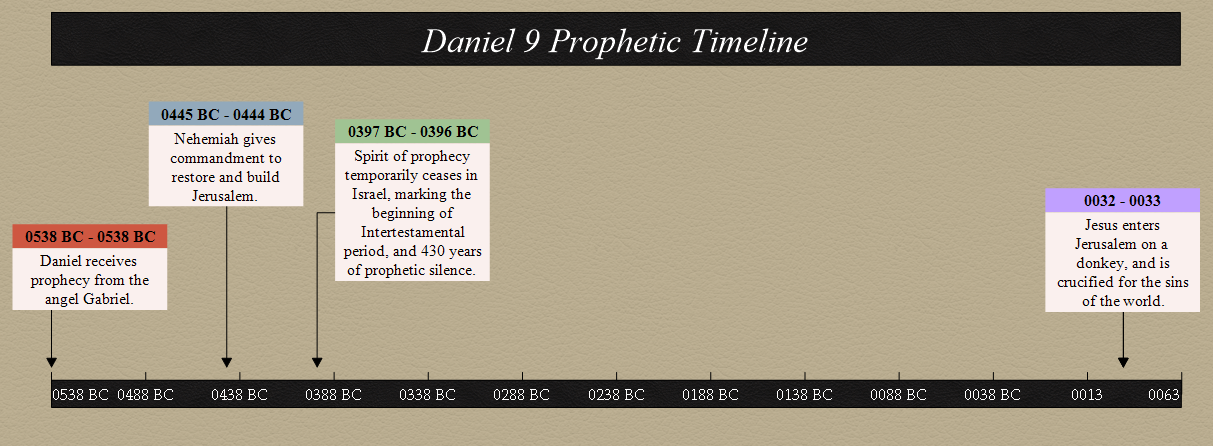
Daniel chapter 9 contains one of the most astonishing prophecies in all of Scripture—a prophetic countdown that foretells not only the arrival of the Messiah, but also the very year of His death. Most commonly known as the 70 weeks prophecy, this passage is unique in that it is the only prophecy in the Bible which provides a specific chronological countdown—anchored to a historical decree—that foretells the precise timing of future events, including the arrival and death of the Messiah.
As if furnishing us with such a precise prophetic timeline weren’t enough to firmly establish the identity of the Messiah, the Lord has taken it upon Himself to provide an additional layer of irrefutable evidence—hidden within the plain text of this very prophecy. In this article, I am going to reveal two ELS Bible codes encrypted within this passage that reinforce the already self-evident truth that the prophecy is about none other than Jesus Christ.
Before we examine the codes themselves, let us briefly revisit the significance of the prophecy in question.
The 70 weeks prophecy of Daniel 9
The angel Gabriel tells the prophet Daniel that seventy “weeks” (i.e., weeks of years, or 490 years total) have been determined upon the Jewish people and the city of Jerusalem (Dan. 9:24–27). The prophecy states that from the going forth of the command to restore and rebuild Jerusalem, there would be sixty-nine weeks (483 years) until the arrival of the Messiah. Then, startlingly, it declares that the Messiah would be “cut off” (killed), but not for himself.
As I detailed in this earlier post, the book of Nehemiah reveals that the decree to rebuild Jerusalem came in 445/444 BC (Neh. 2:17–18). Given that prophetic time in Scripture is calculated using a 360-day year, this 483-year span must be converted to modern solar years (365.24219 days). When converted, the prophetic period translates to nearly 476 years on our calendar—bringing us precisely to 33 AD, the very year Jesus Christ was crucified.
The precision of this prophetic countdown alone is enough to make it overwhelmingly clear that the prophecy is about Jesus.1 We don’t even need a hidden Bible code to know who this prophecy is about.
But then again—cake always tastes better with icing.
The Daniel 9 Bible code
Now for the deeper revelation. In August of 2021, I discovered two prophetic encryptions buried side-by-side within Daniel 9:25 through Daniel 10:3. Behold:

As can be seen, we have two eerily similar prophetically relevant phrases encoded side by side in this passage.
- כמות השה (kamoot ha-seh) — “When the Lamb will die” (encoded in Dan. 9:25-10:1)
- כמות ישו (kamoot Yeshu) — “When Jesus will die” (encoded in Dan. 9:26-10:3)
In conducting the search which led to these discoveries, I restricted the ELS search range to a maximum skip of 150 letters. The purpose of this constraint was twofold. First, the shorter the letter skip, the greater the topical and contextual confinement of the encryption—making it more likely that any encoded phrase is thematically linked to the surrounding passage. Since the goal of the experiment was to determine whether these phrases were encoded within topically relevant messianic passages, a narrow ELS range was essential. Second, limiting the skip range serves as a statistical filter. When searching for a moderately common string of 6–8 Hebrew letters (such as כמות השה or כמות ישו), an unconstrained search will typically yield hundreds or even thousands of random hits scattered across the Tanakh–false positives where the specified phrase appears encoded just by random chance. Constraining the skip range is therefore one of the most effective ways to reduce this kind of statistical “noise” and isolate potential encodings of genuine significance.
Both phrases appear in this exact prophetic section of the Hebrew Bible—each encoded at short-distance equidistant letter sequences (ELS), and each in reverse letter order.
Encryption Frequency & Statistical Significance
The phrase כמות השה (“When the Lamb will die”) appears at an ELS of every 30 letters, running backward from the kaph in the word לכורש (“to Cyrus”) in Daniel 10:1.
The phrase כמות ישו (“When Jesus will die”) appears at an ELS of every 48 letters, also running backward, beginning at the kaph in the word אכלתי (“I ate”) in Daniel 10:3.

The phrase כמות השה (“When the Lamb will die”) appears at an ELS of every 30 letters, running backward from the kaph in the word לכורש (“to Cyrus”) in Daniel 10:1.
The phrase כמות ישו (“When Jesus will die”) appears at an ELS of every 48 letters, also running backward, beginning at the kaph in the word אכלתי (“I ate”) in Daniel 10:3.
Even when considered individually, each phrase is relatively rare within the Hebrew Bible when limited to the narrow ELS range of 1–150. To be more specific:
– This is 1 of only 7 passages in the Leningrad Codex, and 1 of 6 passages in the Keter Jerusalem text, where כמות השה is found encrypted at short ELS.
– It is also 1 of only 6 passages in the Leningrad Codex, and 1 of 9 passages in the Keter Jerusalem, where כמות ישו appears encrypted at short ELS.
However, when the search is conducted as a two-string query—meaning the computer is instructed to return only those passages where both of these phrases appear encoded together at different ELS values—the result is singular and definitive: Daniel 9:25–10:3. Nowhere else in the entire Hebrew Bible do these two statements appear encrypted together within the same passage.
That these two prophetic phrases appear side by side in the one and only passage that contains a chronological countdown to the death of the Messiah is statistically astonishing. The probability of this occurring by random chance is astronomically low—virtually zero. This is not coincidence. This is intentional. And the fact that this is the only passage in the entire Tanakh where both statements are found together reinforces what the prophecy itself already declares:
This is about Jesus.
Topical relation
While the entire Old Testament is saturated with messianic prophecies (some of which are more obvious than others), Daniel 9:24-27 is unique in that it is literally the only passage in the entire Old Testament that provides a precise prophetic timeline which forecasts the first coming of the messiah, and also predicts the precise year of his sacrificial death. The prophecy predicts that the messiah would be “cut off” (killed) 69 weeks (483 years) after the decree to rebuild Jerusalem unto the messiah was issued. As I demonstrated a recent article, the book of Nehemiah reveals that this commandment came by the mouth of Nehemiah in the year 445/444 BC (Neh. 2:17-18). I explained how biblical prophecy always goes by a 360-day year, and therefore the 483 years of the Daniel 9 prophecy must be converted to 365.24219 day years before we can calculate the precise year of the messiah’s death on our modern Western calendar using the information given in the prophecy. We saw how 483 years of 360 days translates to almost exactly 476 years on our modern Gregorian calendar, and 476 years from the year 444 BC takes us to the year 33 AD—the year that our Lord was crucified. Thus, by encrypting the statements “When the Lamb will die” and “When Jesus will die” in this specific passage, God is affirming that Jesus is the Messiah, and that this prophecy in Daniel 9 is indeed about him. It is as if he is saying: “Yes, this is a prophetic countdown to the year of my death. Enjoy.”2
Conclusion: The Daniel 9 Bible code confirms that Jesus is the subject of the prophecy.
A wise man once said, “Let us hear the conclusion of the whole matter.” (Ecclesiastes 12:13)
Here is the conclusion:
The prophecy of Daniel 9 foretold—centuries in advance—the precise year the Messiah would appear and be cut off. And encoded directly within that very passage are two phrases—“When the Lamb will die” and “When Jesus will die”—that confirm who that Messiah is. This is no coincidence.
The encrypted witness, buried deep in the structure of the text, reinforces the plain-sense reading of the surface prophecy. The God of Israel has left His signature—one in plain ink, the other in encrypted form—so that we would know, without excuse, that Jesus Christ is the Messiah foretold by Daniel the prophet.
It is as though God is saying:
“Yes, this is a prophetic countdown to the year of my death. Enjoy.“
The writing is on the wall—and in the text. Just as God once wrote with His own hand upon the wall of a Babylonian palace, so too has He inscribed the identity of the Messiah within the text of the only prophecy in the Bible which foretells the year of his death.
© 2022 – 2025, Zerubbabel. All rights reserved.
 Copyright secured by Digiprove © 2022 Zerubbabel
- In fact, it is my conviction that this prophecy was so devastating to the Pharisees’ case that Jesus was not the Messiah, that the early rabbinical authorities later rejected the prophetic authenticity of the book of Daniel altogether—demoting it to the Ketuvim section of the Tanakh.
- This is a mere summary of how the prophecy breaks down. For a more in depth discussion of these calculations, see my article on the 70 weeks prophecy.