

ELS Bible codes first gained widespread attention in the 1980s and 1990s, inspiring a wave of scholarly articles, books, and media coverage. The idea that meaningful, hidden messages could be encoded within the Hebrew Scriptures fascinated both researchers and the general public. However, as interest grew, so did the backlash. Skeptical studies—often based on flawed methodologies—attempted to dismiss the phenomenon as mere statistical coincidence. Critics waged an aggressive PR campaign against the concept, and over time, they succeeded in convincing the majority that Bible codes had been thoroughly ‘debunked.’
Today, the mere mention of ELS Bible codes is often met with eye-rolls, as if the subject is settled. But this assumption is not only premature—it is demonstrably false.
In this article, I will prove beyond reasonable doubt that ELS Bible codes exist by presenting multiple irrefutable examples from my own research. These codes are statistically improbable, thematically precise, and contextually meaningful. Far from being a discredited idea, the presence of these codes in the Hebrew Scriptures is an undeniable reality—one that no honest examination of the evidence can ignore.
What are ELS Bible codes?
The acronym ELS stands for Equidistant Letter Sequencing. When I speak of ELS codes in the Bible, I am referring to coherent messages encrypted within the Hebrew text of the Old Testament at equidistant letter sequences, which are either directly prophetically and contextually relevant to the biblical passages in which they are encoded, or which combine with specific elements of the plain text of the passages in which they occur to form new cohesive prophetic messages which exist independently of the plain text narrative. To use a very simple example which provides us with one particular basic rendering of what this can look like, behold the following verse from the book of Psalms:

As the highlighted letters of the original Hebrew text demonstrate–if you start at the very first letter of the verse in the Hebrew and skip every 5 letters, every 5th letter spells out אשיר לו (pronounced “Ah-shir lo”), which is Hebrew for: “I will sing to him.” Behold:

As can be seen, here we have a coherent meaningful statement encrypted within a single verse at an equidistant letter skip sequence of every 5 letters. We can also see that the encoded message is coherent, and we can also see that it is directly topically relevant to the plain text of the verse in which it occurs–a manifest token of its authenticity. One need not be a statistician to acknowledge that this occurred by deliberate design, as such miracles simply do not occur by chance. Like Thomas Jefferson, we hold this truth to be self-evident.
The origins of ELS Bible code research
The history of the ELS Bible codes phenomenon begins in the Middle Ages with a medieval Jewish Rabbi by the name of Rabbeynu Bachayah (1255 – 1340 CE). In his Torah commentary written in the year 1291 CE, Bachayah stated the word בּהרד is encrypted in Genesis 1 at 42 letter intervals (every 42nd letter), starting at the first letter of Genesis 1:1. He then argued that this word had been deliberately encrypted at the beginning of Genesis 1 by God, who was using it to establish a connection between the birth of the luminaries and the birth of the world.
Although his exegetical argument is questionable, the actual method he employed of finding words in the text by skipping a particular number of letters in the text was nothing short of revolutionary. This is the first documented instance of a biblical commentator using equidistant letter sequencing. Unfortunately, Bachayah’s method was largely unnoticed, and ELS Bible code research would lay dormant for another six centuries.
In the twentieth century, a Jewish Rabbi by the name of Michael Dov Weissmandl happened to learn of the ELS Bible codes phenomenon while reading Bachayah’s commentary on Genesis. This aroused Weissmandl’s interest and curiosity enough to conduct his own personal experiments. Using only a set of index cards, Weissmandle discovered that if you begin at the ת in the very first word Genesis and skip 50 letters a total of three times, every 50th letter spells out the word תּורה (“Torah”). This and other similar findings would ignite modern interest in the idea of ELS codes in the Bible. As fate would have it, the advent of the personal computer after Weissmandle’s death would eliminate the agonizing time-consuming process of manual counting, and make it possible for biblical cryptographers to uncover ELS Bible codes in the Hebrew Scriptures within a matter of a few seconds.
How ELS Bible codes are found
Finding ELS codes in the Bible is a lot like mining for gold. Biblical cryptographers like myself labor to uncover ELS Bible codes through the use of a special computer program designed to perform equidistant letter-skip searches on the Hebrew text of the Old Testament.
How an ELS search works
To conduct an ELS search, the code researcher begins by entering a specified range of letter skip intervals to have the program search for codes. So for example, a range of 1-500 would tell the computer to search for codes at all letter-skip intervals between 1 and 500. One can set the range to as small or as a large as they like. Codes found at smaller letter skip intervals will inevitably have a smaller containing passage, while codes found at extremely large letter skip intervals can transfers across multiple books of the canon.
Because this article serves only as an introduction to the phenomenon of ELS Bible codes and my goal is merely to prove that such Bible codes exist in the most simple and clear way possible–all examples of Bible codes in this analysis will be codes that were found with the specified ELS search range set to 1-150.1 An added benefit of this is that you can get a Hebrew Bible and manually count the letters for yourself to verify that all of the codes I am going to share are there.
Once a desired ELS range has been specified, the code researcher then simply inputs the desired Hebrew text-string that he or she wants the program to search for. The program then scans the text of the entire Hebrew Bible at the specified ELS depth and generates a result set containing a list of every biblical passage where that text-string is encoded. Once a search has been conducted, the code researcher must then go through and analyze each positive result in the results set. When the content of the encoded text-string is directly prophetically or contextually relevant to the biblical passage in which it is encoded (as we saw with the above example with Psalm 69:30), it is generally safe to conclude that you are dealing with an authentic biblical ELS code.2
Christian Opposition to ELS Bible codes
While the idea of divinely planted ELS codes in the Bible might seem like a dream come true for the Christian apologist, not everyone within the household of faith is convinced that the phenomenon is real. Ironically, some of the fiercest opposition to the idea of ELS codes in the Bible emanates from within the Church. While some believers are just plain skeptical that ELS Bible codes exist, others with a more religious bent make the argument that God does not speak cryptically or in riddles, and many mentally associate the idea of scouring the Bible looking for codes as a form of divination.3 As I stated in a previous post last year, these arguments are absolutely ridiculous and cannot be defended biblically. And for the record, the Bible does in fact state that God speaks cryptically and in riddles (Ps. 49:4; 78:2; Matt. 13:34-35).
The Bible gives a very simple criterion for determining whether or not a particular doctrine or teaching is of God. Simply put, if the doctrine or teaching testifies that Jesus Christ has come in the flesh, then it is of God (1 John 4:2-3). It thus follows that if we find ELS codes in the Bible which testify that Jesus Christ has come in the flesh, then we can be certain that the phenomenon is not only real, but is also of God. As we are about to see, the ELS codes in the Bible do testify of Jesus Christ, which thereby proves objectively that they are in fact of God.
The Three classes of ELS Bible Codes
Based on my analysis of the ELS Bible codes I have uncovered in my research thus far, I have identified what I perceive to be approximately three major categories of ELS codes in the Bible.4 These are as follows:
Testimonial ELS codes (Type 1): ELS codes which testify of the divinity & messianic identity of Jesus Christ.
Commentarial ELS codes (Type 2): ELS codes which constitute a form of divine commentary on what is going on in the containing passage.
Reinforcement ELS codes (Type 3): ELS codes which echo a particular key word or concept in the containing biblical passage.
Because I am attempting to prove that ELS Bible codes are both real as well as “of God”, all of the ELS codes that I am going to present in this article are going to be of the Type 1 variety. I will cover Type 2 and Type 3 ELS Bible codes in future discussions.
Examples of Type 1 ELS Bible Codes
Type 1 ELS codes are what I refer to as testimonial ELS codes. The defining feature of this particular category of ELS Bible codes is that they testify of the divinity and messianic identity of Jesus Christ. This type of code comes in a number of different flavors; some are declarative (e.g. “Jesus was beaten.”), others are prophetic (e.g. “Jesus will return.”), others laudative (e.g. “Jesus is worthy.”), and still yet others identifying (e.g. “Jesus is my name.”). In order to get a feel for the nature of Type 1 ELS Bible codes and some of these different ways that they can manifest, let us consider a few examples.
Example 1
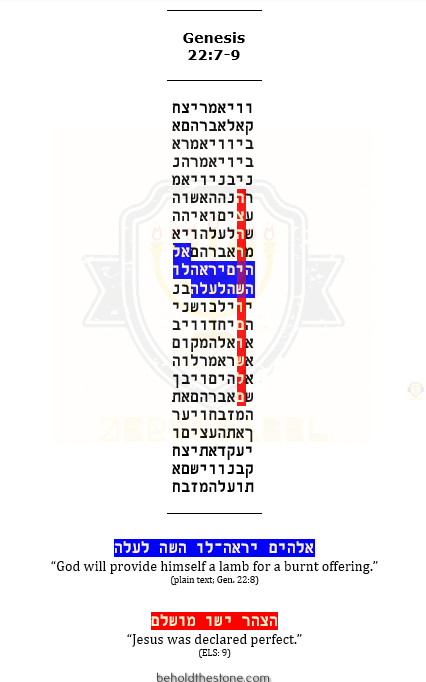
The first Bible code I am going to share is found in Genesis 22.5 The code consists of 3 words, 12 letters, begins in verse 7, and ends in verse 9. The code is found at an ELS of every 9 letters, reads from right-to-left, and is not encoded in any other passage in the entire Hebrew Bible within the specified ELS range of 1-150 letter skips. Here it is in tabular view (to view it as it appears in the grid, click here):
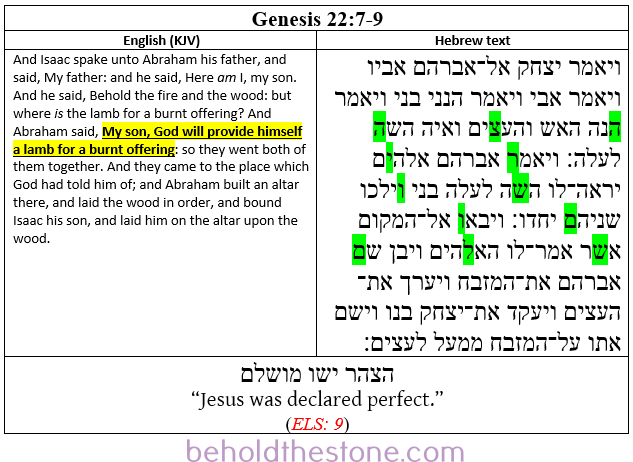
The topical relation between the encoded message and the biblical passage in which it is encoded should be blatantly obvious and need no explanation. First, it should be noted that this scene in Genesis 22 is one of the most memorable Old Testament prophecies concerning the sacrificial death of Jesus Christ. As Abraham and Isaac are journeying up to Mount Moriah, Isaac turns to his father and asks him where is the lamb for the burnt offering, to which Abraham essentially replies (paraphrasing): “Oh, don’t you worry about that son—God will provide himself a lamb for a burnt offering.” What is so powerful about this statement is that Abraham himself would have undoubtedly been completely oblivious to the prophetic significance of his own words, as he was unknowingly prophesying the future death of Jesus Christ, who was foreordained before the foundation of the world to become the Lamb who would take away the sins of the world (John 1:29; 1:36).
The fact that we find the statement “Jesus was declared perfect” encoded behind this specific passage in Genesis 22 is therefore no coincidence. Jesus is the perfect spotless Lamb that God through the mouth of Abraham promised he would provide for a burnt offering. He alone kept the righteousness of the Law by living a sinless and morally perfect life, and in so doing became the substitute for all who believe in him.
Because the encoded text-string is a declarative statement about Jesus, this particular Type 1 ELS code is declarative in its orientation.
Example 2
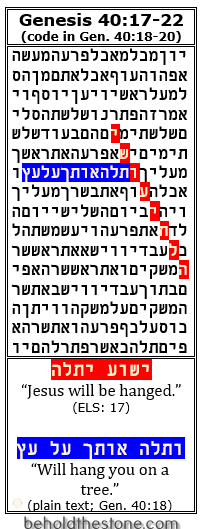
The following Type 1 ELS code was discovered on February 14, 2021. It is encoded at an ELS of every 17 letters, and begins in verse 18 of Genesis 40. Here yet again, this encoded statement is not encoded in any other passage in the Bible within the short-distance ELS range of 1-150 letter skips. Behold:
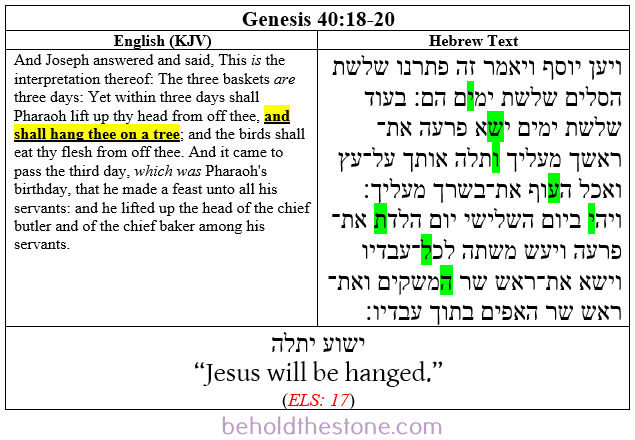
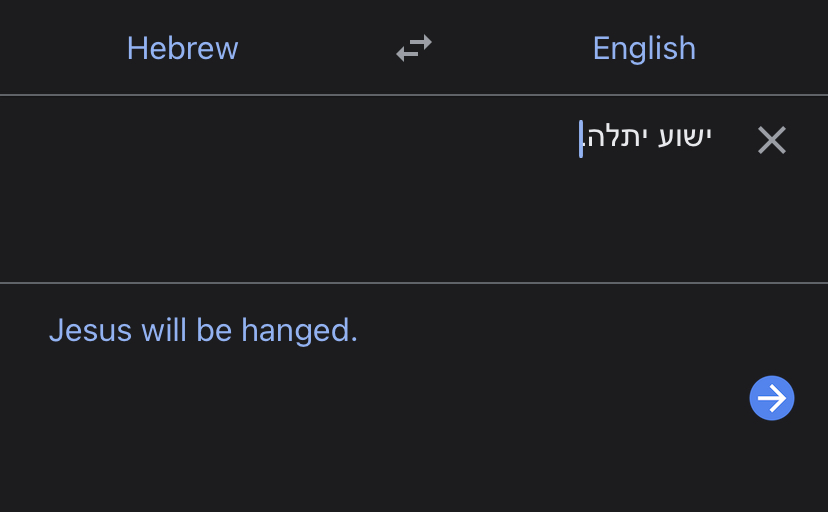
As the figure above reveals, the Hebrew statement ישוע יתלה (“Jesus will be hanged”) is encoded at an ELS of every 17 letters in Genesis 40:18-20.6 Once again, the topical relation between the encoded message and the specific biblical passage containing it is self-evident. In this passage, Joseph is interpreting the dream of Pharaoh’s chief baker whom he encountered while in prison. Joseph tells him that the three branches he saw in his dream symbolized three days, and that within three days Pharaoh would lift up his head and hang him on a tree.
It is worth noting that the Law of Moses would later declare that anyone who was hung on a tree was cursed of God (Deut. 21:22-23). The Apostle Paul would later quote this Scripture to show how Jesus became a curse for us (Gal. 3:13). Indeed, the cross was referred to as a tree four times in the New Testament (Acts 5:30; 10:39; Gal. 3:13; 1 Pet. 2:24). The fact that we have the statement “Jesus will be hanged” encoded in this specific biblical passage (in which Joseph tells Pharaoh’s baker that he will be hanged upon a tree), is obviously no coincidence. Once again, a search for this encoded message at an ELS range between 2-200 shows that this is the only place in the entire Hebrew Bible where this phrase is encoded. This is the fingerprint of God.
Because the encoded text-string proclaims something that would be fulfilled by Jesus at a future point in history, this particular Type 1 ELS code is prophetic in orientation.
Example 3
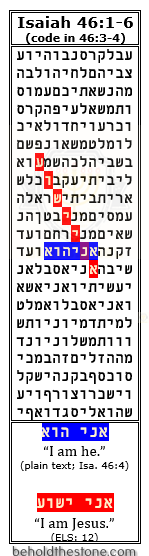
In many Type 1 ELS codes, the encrypt-er reveals his personal identity by speaking in the first-person. Such is the case with the following ELS code, also discovered in February of 2021:7

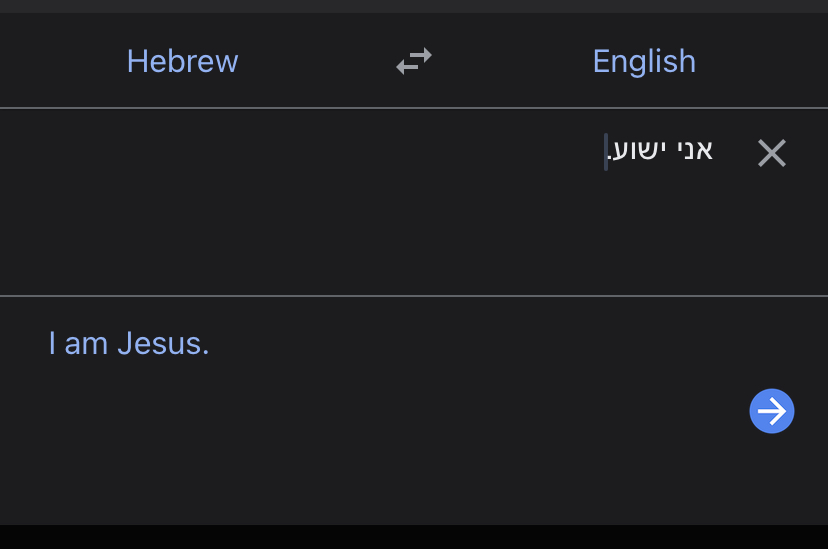
Here we have yet another case in which the topical relation between the encoded message and the passage containing it is self-evident. The fact that we find the statement אני ישוע (“I am Jesus”) encoded at an ELS of every 12 letters backwards in these two verses in which the LORD tells the house of Jacob that it is he who bore them and will carry them, is obviously no coincidence. It is as if Jesus encoded this here to say “I am Jesus who bore you and who continues to carry you, even though you despised and rejected me.”
Because the encoded statement identifies both the encoder and speaker of the containing biblical passage as Jesus, this Type 1 ELS code is identifying in its orientation.
Example 4
In some type 1 ELS codes, the identity of the speaker or subject of the containing biblical passage is identified more subtly using hints. Such is the case in the following Type 1 ELS code that I discovered on February 21, 2021:8

The Hebrew phrase Yeshu yitkadosh is found encoded at an ELS of every 52 letters backwards in Isaiah 43:7-14. This is the only place where this eight-letter phrase appears encoded in the Hebrew Bible within the specified ELS search range of 1-150 letter skips.
The word yitkadosh in biblical Hebrew is a form of the verb qadosh, which is the verb “to sanctify.” It appears here in the imperfect tense (indicating future action in English), and the Hitphael voice, which indicates that the action is reflexive—meaning that the subject imparting the action of the verb is also the recipient (direct object) of the action of the verb. Taken together, the encoded phrase literally translates as: “Jesus will sanctify himself.”
To sanctify simply means to set apart. Thus, the encoded statement is stating that Jesus will set himself apart. Knowing this, it is painfully obvious that this statement is not encoded in this specific passage by random chance, as God himself is speaking in the first person in the plain text of the containing passage, quite literally explaining what sets himself apart from all of the heathen “gods” who his people ignorantly worship. Thus this particular Type 1 ELS Bible code testifies that Jesus Christ is the God of Israel, and that he is the one and only true and living God–and the one and only Savior.
The obvious topical relation combined within the exclusivity of the encryption in this example prove that this is authentic Type 1 ELS Bible code put here by God himself.
Authenticity of code reinforced further by the Canonical Column
The authenticity of this particular ELS Bible code is even further reinforced by the Canonical Column. Note that the encoded statement in this example is found entirely in Isaiah 43. In the Canonical Column, Isaiah 43 corresponds to the Gospel of John–the 43rd book of the Bible. This is profoundly significant, because John’s Gospel is the only book in the entire New Testament where Jesus makes the following unique declaration:
And for their sakes I sanctify myself, that they also might be sanctified through the truth. (John 17:19)
Even more remarkably, the only other place in all of Scripture where God speaks in the first person and declares “I will sanctify myself” is Ezekiel 38:23. In other words, we are dealing with an extremely rare and exclusive divine statement that occurs a total of only two times in the plain text of the Bible.
Thus we have the statement: “Jesus will sanctify himself” encrypted exclusively in Isaiah 43,9 a chapter which functions in the Canonical Column as a figurative type of the Gospel of John, which is one of two books in the entire Bible where God makes the statement: “I sanctify myself.”
Such precise interlocking between encrypted text, canonical structure, and plain-text revelation could not have occurred coincidentally. This demonstrates a level of intentionality, logic, and orchestration which is indicative of divine design.
Example 5
This next example is one of my favorite Type 1 ELS Bible codes that I’ve uncovered.10

As can be seen, the statement amad yeshua (“Jesus stood”) is encoded at an ELS of every 3 letters backwards in Psalm 130:3, beginning at the ayin in the last word of the verse. Here yet again I must emphasize that this is the only place in the entire Hebrew Bible where this precise seven letter string appears encoded in the Hebrew Bible within our specified ELS search range of 1-150 letter skips. This exclusivity, combined with the obvious topical relation to its containing verse is more than enough to prove that this is a deliberately encoded message.
I think the meaning of the code is so self-evident in this example that it doesn’t need explaining, but for those of you who would like some explication & analysis—I have written about this code in greater detail here.
Example 6
The following type 1 ELS code was discovered on May 30, 2022, at 5:48 a.m:11

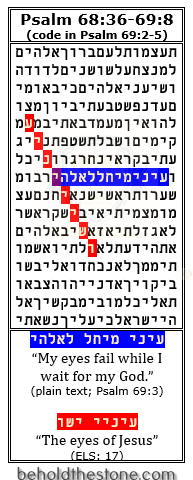
As can be seen, the Hebrew phrase עיניי ישו (ayinee yeshu (literally: “the eyes of Jesus“)) is encrypted in Psalm 69:2-5 at an ELS of every 17 letters, beginning at the ayin in the word במעמקי in verse 2. In all three of our base texts, this is the only passage in the entire Hebrew Tanakh where this eight-letter string appears encrypted within our specified ELS search range of 1-150.
One interesting thing about this code is that the construct noun ayini (eyes) in the encoded phrase includes an additional yod at the end. The reason that is interesting is because this particular use of the double yod is a grammatical feature that is exclusive to modern Hebrew–a form of the language which obviously did not even exist at the time when the Hebrew Bible was written.12 How is this possible? It’s possible because Jesus is God–with whom all things are possible (Matt. 19:26; Mark 9:23, 10:27, 14:36; Luke 18:27).
This particular Type 1 ELS is identifying in its orientation, in that it reveals Jesus to be the first-person speaker in the plain text of the passage. To word that in a slightly different way, it identifies Jesus as the spirit of prophecy speaking through the mouth of David in this psalm. Notice that the encryption forces us to look at this psalm in a different light. What before appeared to be merely random laments of David with regard to trials that he was experiencing at some particular time in his life, suddenly becomes a prayer of Jesus in which he is describing the anguish and rejection that he was experiencing during his earthly ministry. One way to frame this, is to imagine that David was (by the inspiration of the Holy Spirit) unknowingly channeling a prayer that Jesus’ would later make on earth during his earthly ministry over a thousand years later. Viewed through this lens, the innumerable multitude of whom the speaker speaks in the containing passage, whom he claims hate him “without a cause,” (v. 4) refers to the Jewish rabbinic establishment who so vehemently opposed Jesus during his earthly ministry.13
Example 7
I discovered the type 1 ELS code charted below on August 6, 2021 at 7:29a.m.:
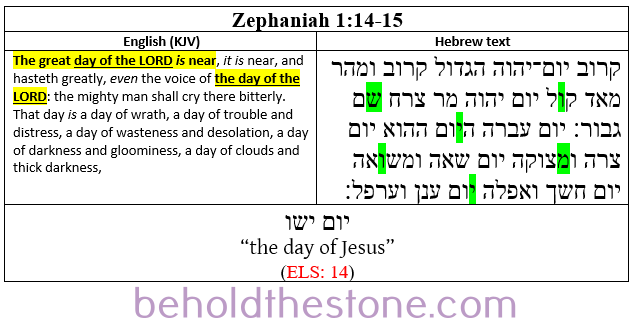
The Hebrew construct chain יום ישו (“the day of Jesus”) is encoded in Zephaniah’s description of the coming day of the LORD.14 The message the code is conveying here could not be possibly more obvious, namely–Jesus and the LORD (“Yahweh”, “Jehovah”) are one and the same.15
Because the primary function of the encoded text-string is to clarify the personal identity of “the LORD,” (a-k-a “Yahweh” or “Jehovah”), this type 1 ELS code is identifying in its orientation.
Statistical Improbability of Short-Distance ELS Codes
One of the most common objections raised by skeptics is that ELS codes can be found in any sufficiently large text, such as Moby Dick or War and Peace. However, this argument fails to account for key statistical factors that make biblical ELS codes unique.
First and foremost, in this study, I limited my ELS search range to a maximum of 150 letter skips—a crucial restriction that vastly reduces the probability of finding meaningful sequences. This means that instead of searching for codes across the entire Tanakh without constraints, I constrained the search to short-distance ELS codes that appear within a much smaller window.
This restriction makes a massive difference in the probability calculations. Consider the following:
1. The Scale of the Hebrew Bible
- The entire Tanakh contains approximately 1,196,000 letters.
- A seven-letter Hebrew phrase (for example) could theoretically occur anywhere within this massive dataset.
- However, once we impose the 150-letter maximum skip constraint, the potential locations for a code shrink dramatically.
2. The Probability of Finding a Specific Phrase
To illustrate how improbable these codes are, let’s take one of the examples in this study:
- The phrase “Jesus will be hanged” (ישוע יתלה) consists of 7 specific Hebrew letters appearing in the correct order within a passage.
- If we assume a uniform distribution of letters, the probability of randomly forming this phrase at any specific ELS is approximately: (1/22)7, since biblical Hebrew has 22 letters, and each letter must appear in the correct order.
- Now, factor in the additional constraint: the ELS cannot exceed 150 letter skips. This restriction further limits the available search space and dramatically lowers the likelihood of finding such a phrase at all.
3. The Thematic Relevance Factor
Even if an encoded phrase were to occur randomly, the likelihood that it would be directly relevant to the plain text of its surrounding passage is even more minuscule.
For instance, in Genesis 40:18-20, we find “Jesus will be hanged“ encoded within a passage that describes a man being hanged on a tree. This is not just an ELS sequence—it is a thematically perfect prophecy embedded within the passage itself.
For a random ELS sequence to both exist within the 150-letter constraint AND align prophetically with its containing passage is so statistically improbable that it is best explained as deliberate design rather than chance.
4. The Validity of Long-Distance Bible Codes
While this study focuses on short-distance Bible codes, it is important to note that long-distance ELS codes can also be significant—provided they align with prophetic themes and maintain a clear connection to the surrounding text.16 The issue with skeptical counterexamples is not the distance of the codes but rather their complete lack of contextual or prophetic relevance.
- Skeptics often generate long-distance codes with no connection to the surrounding plain text, making them meaningless.
- In contrast, meaningful long-distance codes, like short-distance ones, follow an intentional pattern where the encoded message aligns with the content of the containing passage.
- Some of my own discoveries—though beyond the scope of this study—demonstrate that long-distance ELS codes can be just as impressive as short-distance ones when viewed on a properly generated grid.
5. The Inconsistency of Skeptical Counterarguments
When skeptics claim that “similar codes” can be found in Moby Dick or other texts, they almost always rely on long-distance ELS codes with no contextual relevance.
- Random letter sequencing allows for phrases to emerge when skips of thousands of letters are used, but these lack any connection to the surrounding text.
- In contrast, biblical ELS codes that are short-distance, thematically relevant, and prophetically meaningful are far beyond statistical coincidence.
Conclusion: The Divine Signature
The use of short-distance ELS codes adds an extra layer of precision that makes it mathematically impossible for these findings to be the product of mere chance. The fact that these codes overwhelmingly testify to Jesus Christ as the Messiah, appearing in messianic passages of the Tanakh, further confirms that they were intentionally placed there by the divine Author of Scripture.
The Purpose of ELS Bible Codes
In addition to functioning as a prophetic witness of Jesus Christ, ELS Bible codes also function as watermarks of authenticity and an additional supplementary layer of biblical revelation.
Watermarks of authenticity
When I say that ELS Bible codes function as watermarks of authenticity, I mean that they attest to the divine inspiration of the Hebrew Scriptures. The fact is that human beings do not possess the level of intelligence that is required to plant such an elaborate system of ELS codes in the Bible. Thus far in this analysis, all of the examples I have shared have shown a single encoded text-string per containing passage. However, the reality is that any given Old Testament passage has a potentially infinite number of meaningful encrypted messages present within it. Allow me to demonstrate using an example with multiple encoded text-strings:
Genesis 44:30-45:12
English (KJV)
Hebrew text
Now therefore when I come to thy servant my father, and the lad be not with us; seeing that his life is bound up in the lad’s life; It shall come to pass, when he seeth that the lad is not with us, that he will die: and thy servants shall bring down the gray hairs of thy servant our father with sorrow to the grave. For thy servant became surety for the lad unto my father, saying, If I bring him not unto thee, then I shall bear the blame to my father for ever. Now therefore, I pray thee, let thy servant abide instead of the lad a bondman to my lord; and let the lad go up with his brethren. For how shall I go up to my father, and the lad be not with me? lest peradventure I see the evil that shall come on my father. Then Joseph could not refrain himself before all them that stood by him; and he cried, Cause every man to go out from me. And there stood no man with him, while Joseph made himself known unto his brethren. And he wept aloud: and the Egyptians and the house of Pharaoh heard. And Joseph said unto his brethren, I am Joseph; doth my father yet live? And his brethren could not answer him; for they were troubled at his presence. And Joseph said unto his brethren, Come near to me, I pray you. And they came near. And he said, I am Joseph your brother, whom ye sold into Egypt. Now therefore be not grieved, nor angry with yourselves, that ye sold me hither: for God did send me before you to preserve life. For these two years hath the famine been in the land: and yet there are five years, in the which there shall neither be earing nor harvest. And God sent me before you to preserve you a posterity in the earth, and to save your lives by a great deliverance. So now it was not you that sent me hither, but God: and he hath made me a father to Pharaoh, and lord of all his house, and a ruler throughout all the land of Egypt. Haste ye, and go up to my father, and say unto him, Thus saith thy son Joseph, God hath made me lord of all Egypt: come down unto me, tarry not: And thou shalt dwell in the land of Goshen, and thou shalt be near unto me, thou, and thy children, and thy children’s children, and thy flocks, and thy herds, and all that thou hast: And there will I nourish thee; for yet there are five years of famine; lest thou, and thy household, and all that thou hast, come to poverty. And, behold, your eyes see, and the eyes of my brother Benjamin, that it is my mouth that speaketh unto you.
ועתה כבאי אל־עבדך אבי והנער איננו אתנו ונפשו קשורה בנפשו׃ והיה כראותו כי־אין הנער ומת והורידו עבדיך את־שיבת עבדך אבינו ביגון שאלה׃ כי עבדך ערב את־הנער מעם אבי לאמר אם־לא אביאנו אליך וחטאתי לאבי כל־הימים׃ ועתה ישב־נא עבדך תחת הנער עבד לאדני והנער יעל עם־אחיו׃ כי־איך אעלה אל־אבי והנער איננו אתי פן אראה ברע אשר ימצא את־אבי׃ ולא־יכל יוסף להתאפק לכל הנצבים עליו ויקרא הוציאו כל־איש מעלי ולא־עמד איש אתו בהתודע יוסף אל־אחיו׃ ויתן את־קלו בבכי וישמעו מצרים וישמע בית פרעה׃ ויאמר יוסף אל־אחיו אני יוסף העוד אבי חי ולא־יכלו אחיו לענות אתו כי נבהלו מפניו׃ ויאמר יוסף אל־אחיו גשו־נא אלי ויגשו ויאמר אני יוסף אחיכם אשר־מכרתם אתי מצרימה׃ ועתה אל־תעצבו ואל־יחר בעיניכם כי־מכרתם אתי הנה כי למחיה שלחני אלהים לפניכם׃ כי־זה שנתים הרעב בקרב הארץ ועוד חמש שנים אשר אין־חריש וקציר׃ וישלחני אלהים לפניכם לשום לכם שארית בארץ ולהחיות לכם לפליטה גדלה׃ ועתה לא־אתם שלחתם אתי הנה כי האלהים וישימני לאב לפרעה ולאדון לכל־ביתו ומשל בכל־ארץ מצרים׃ מהרו ועלו אל־אבי ואמרתם אליו כה אמר בנך יוסף שמני אלהים לאדון לכל־מצרים רדה אלי אל־תעמד׃ וישבת בארץ־גשן והיית קרוב אלי אתה ובניך ובני בניך וצאנך ובקרך וכל־אשר־לך׃ וכלכלתי אתך שם כי־עוד חמש שנים רעב פן־תורש אתה וביתך וכל־אשר־לך׃ והנה עיניכם ראות ועיני אחי בנימין כי־פי המדבר אליכם׃
Note that we have a total of four Type 1 ELS codes running through the above passage of Scripture in the original Hebrew. Behold:
| Encoded text-string | Translation | Letter-skip interval | Direction | Corresponding Scriptural statements |
| אמות: אני ישו | “I will die; I am Jesus.” | 97 | natural | Gen. 44:31; Gen. 45:3-4 |
| המושיע | “The Savior” | 95 | retrograde | Gen. 45:7 |
| אני חי | “I am alive.” | 11 | natural | Gen. 45:26-28 |
| פיו ישוע | “His mouth is Jesus.” | 53 | natural | Gen. 45:12 |
The fact that we find multiple contextually relevant prophetic statements about Jesus Christ encoded in what is one of the oldest books of the Hebrew Bible is enough by itself to prove that the author of the codes is someone who is not bound by the laws of time and space.17 But let us push that fact to the side for just a moment, and briefly shift our attention to the fact that we have four coherent contextually relevant encrypted messages (all encoded at completely different letter-skip intervals), simultaneously present in the same biblical passage.18 Try to reflect on the level of intelligence one would have to possess to have successfully encrypted all of these biblical statements in this passage. The hand responsible for these codes is having to narrate a story, while at the same time is having to order his words in such a way that not just one, but many prophetically meaningful and contextually relevant statements are encrypted within the passage at completely different letter skip intervals–each of which alludes to specific statements or pieces of dialogue spoken in the containing passage. And as if all of that is not enough, he is having to do all of this while somehow faithfully abiding by all of the grammatical laws of the ancient Hebrew language. Fallen human beings simply do not possess the level of intelligence required to accomplish such a feat. This necessitates a level of intelligence which can only be described as superhuman. This could only have been done by someone who is perfect in knowledge, and infinite in understanding. There is only one man who could have been responsible. (Job. 36:4; 37:17; Ps. 147:5)
An additional layer of biblical revelation
In addition to functioning as watermarks of authenticity, ELS Bible codes also function as a supplemental layer of biblical revelation which in many cases can shed light on the prophetic meaning of the biblical passage containing them. To revert back to our previous example of Genesis 44:31-45:12 to illustrate, the four ELS Bible codes we saw there reveal that Joseph’s revelation of himself to his brothers (who had previously despised and rejected him) is a prophetic foreshadowing of Jesus Christ making his identity known to his brethren the house of Jacob at his second coming. A careful analysis of the content of each encoded statement, alongside the specific pieces of dialogue in the containing passage that each statement is alluding to–inevitably leads one to this conclusion. Let us break these down one by one.
1. “I will die; I am Jesus.”
This complete encoded statement can be broken down into two distinct statements: “I will die,” and “I am Jesus.” When read together as one complete sentence, what we have here is a cryptic prophecy in which Jesus speaks in the first-person and foretells his sacrificial death, and then proceeds to identify himself by name. However, it must be noted that each of these statements alludes to two different pieces of dialogue made by various characters in the containing passage. On the one hand, the statement “I will die” begins in Genesis 44:31, and alludes to Judah’s statement to Joseph that if he (Judah) returns to their father without Benjamin–their father (Israel) will die.19 The second part of the encoded text-string (“I am Jesus”), begins in Genesis 45:4, where Joseph is revealing his identity to his brothers with the three-word statement: “I am Joseph.” What this does is it sheds light on the prophetic meaning of the containing passage, revealing that Joseph’s revelation of himself to his brothers (who had previously despised and rejected him) is a prophetic foreshadowing of Jesus Christ making his identity known to his brethren the house of Jacob at his second coming.
2. “The Savior”
The phrase “The Savior” also begins in Genesis 45:4, and runs through verse 11. Through this encoded phrase Jesus affirms and reinforces his identity. Within the context of the containing passage, this encoded phrase specifically alludes to Joseph’s statement to his brothers in Gen. 45:7 that their rejection of him many years prior was divinely ordained, so that through him God might save their lives by a great deliverance. He that hath ears to hear, let him hear what the spirit of prophecy saith.
3. “I am alive.”
To this day, most Jews believe that Jesus Christ was merely a man who has now been dead for almost 2,000 years. The encoded statement אני חי (“I am alive”) alludes to the fact that (just as Joseph had long been presumed to be dead, yet was alive (Gen. 45:26-28; 46:30; cf. Rev. 1:18)), so to the unbelieving house of Jacob is going to one day be very suddenly confronted with the realization that the one whom they despised and rejected is very much alive and well.
4. “His mouth is Jesus.”
The encoded statement “His mouth is Jesus” is a direct allusion to Joseph’s statement made in Gen. 45:12:
And, behold, your eyes see, and the eyes of my brother Benjamin, that it is my mouth that speaketh unto you.
(KJV, Genesis 45:12)
Here yet again, the encoded statement sheds light on the prophetic meaning of the containing passage, affirming that Joseph’s revelation of himself to his brothers is a prophetic foreshadowing of Jesus revealing his identity to his Jewish brethren at his Second Coming.
Conclusion
The idea that ELS Bible codes have been ‘debunked’ is a myth built on flawed methodologies and misrepresentations. Skeptical studies rely on arbitrary, long-distance codes with no thematic relevance—an approach that does not reflect the true nature of the phenomenon. When examined correctly, using short-distance ELS codes within prophetic and contextually relevant passages, the evidence becomes undeniable.
The codes in the Hebrew Scriptures are not random. They are deliberate, intentional, and topically relevant to the passages in which they are found. All of the codes I have shared in this analysis are both topically relevant to the passages in which they appear, and most of them are exclusive to the passages in which they are found as well. Codes of this nature do not occur by random chance–they reflect the deliberate, willful design of an intelligent encoder.
Collectively, ELS Bible codes function as a sort of divine seal which verifies the authenticity of the Hebrew Bible. These discoveries force us to reconsider what we thought we knew about the structure of Scripture and the hand of God in its composition. Bible codes have not been debunked or discredited, and anyone who says that they have is merely regurgitating a narrative based on the counterfeit experiments of the skeptics who managed to win the PR war.20 The existence of ELS Bible codes is as certain and verifiable as the scientific laws which govern the natural universe.
Every ELS Bible code I have shared in this analysis is an original discovery from my own research. These codes are not theoretical—they exist and can be verified firsthand using a copy of the Hebrew Tanakh and a simple tool like Google Translate.
For the sake of clarity, all the examples presented here have been short-distance Bible codes, as they are the easiest to verify and demonstrate. However, this is only a glimpse into the full depth of the phenomenon. For more advanced analysis on this subject, see my articles on Bible code grids, and long-distance Bible codes.
© 2021 – 2025, Zerubbabel. All rights reserved.
 Copyright secured by Digiprove © 2021 Zerubbabel
- I refer to codes found at small ELS’s like this as short-distance Bible codes. For a more sophisticated examination which deals with long-distance Bible codes, see this article.
- Obvious and undeniable topical relation between the encoded text string and the containing passage is by far the most obvious and reliable indicator of a deliberately planted ELS Bible code.
- As but one example, Don Stewart makes both of these claims in his essay “Is There a Secret Code in Scripture That Proves Its Divine Authority? (The Bible Code)“
- Note that this categorical system is arbitrary, and I use it mainly for convenience.
- I discovered this code on February 15, 2021.
- This image shows how the code actually appears within the grid.
- To view this code in grid-view rather than table-view, click here.
- To view the full code matrix in the grid, click here.
- As previously noted, this is the only place in the entire Hebrew Bible where the phrase “Jesus will sanctify himself” is found encoded at a short-distance ELS within a localized passage. It appears nowhere else in the Hebrew Scriptures.
- This one was discovered on July 11, 2021.
- For grid-view, click here.
- In biblical Hebrew, the construct noun “eyes” in the phrase “the eyes of Jesus” would contain only one yod at the end, thus the phrase would appear as עיני ישו.
- One obvious objection to the claim that Jesus is the speaker of the passage is that the speaker speaks of “his sins” in verse 5 of the containing passage. On the surface, this appears to disqualify Jesus as the speaker of the psalm, as we know that he is the one person who never sinned (Heb. 4:15; 2 Cor. 5:21). Yet this apparent contradiction is easily reconciled when we understand that the speaker’s sins of which he is speaking in this psalm are in reality the sins of all believing sinners who have been freely justified by faith, because all of the sins of his people were imputed unto Jesus so that he could pay the penalty for them with his own life (Dan. 9:26). As such, it was as if all of “our sins” literally became “his sins” in the eyes of God—while his righteousness literally became our righteousness (Jer. 23:6; 33:16; Rom. 3:26; 4:13).
- In Hebrew, a construct chain is when two nouns are sandwiched together to form one construct. The first noun in the construct chain is what is known as the construct noun, while the second noun is known as the absolute noun. In English, construct chains are typically rendered by inserting the preposition “of” between the construct noun and the absolute noun, and (depending on the nature or state of the absolute noun) by inserting the definite article “the” before the construct noun.
- Jesus is the only begotten human tabernacle which houses the eternal spirit of Yahweh (John 1:14; 10:38; Matt. 17:4-8).
- The Titanic Bible code and the land of America Bible code are both excellent examples of long-distance Bible codes which beautifully demonstrate this point.
- The book of Genesis was written several centuries before the life of Jesus Christ regardless of whether or not one accepts the Mosaic authorship of the Pentateuch, or the Documentary Hypothesis.
- I can almost guarantee with 100% certainty that there are many other similar codes in this passage besides these four which have yet to be discovered.
- For an explanation of how Jesus is metaphorically synonymous with Israel, see my article on the camp of Israel in the wilderness.
- As mathematician, retired code breaker, and Bible code researcher Harold Gans explains in this video, the critics managed to win the PR war by publishing the results of their experiments which produced counterfeit codes in various secular works of literature, and then the publication refused to let Gans and his side respond and publish a counterargument. As a result, the narrative of the critics ultimately prevailed, and as a result the vast majority of the general public falsely believes that ELS Bible codes have been debunked to this day.




This work you have accomplished is of God. I first heard of ELS from Chuck Missler’s ministry. I was led by the Lord to research into this as to its truth. For we know as scripture says “It is God that hides a thing and the duty of King’s (and priest) to search it out”, I am paraphrasing the scripture. Chuck Missler alluded to it and left it to his listeners to research it on their own, he had another mission to accomplish, which he did for certain. Your work is exactly the proof I have been searching. Thank you for following the Lord’s work he has given you.
Billy Martin
Hi Billy,
Thank you so much for your kind words, I was very encouraged by that. I am happy to hear that you found the article edifying. I am acquainted with some of the work of the late great Chuck Missler, and can say that I am a fan. He is sorely missed.
– Zerubbabel
Well done. Thank you for your time and effort. “I will take the foolish things of the world, to confound the wise.” It’s refreshing to see people out there still interested in this subject and doing the research required. I pray that G-d prospers you, even as your soul prospers.
Shalom
Hello Greg,
I apologize that I’m so late responding to this. I just happened to notice your comment while responding to a recent one. I’m guessing I must have forgotten to reply when you originally posted it. Just wanted to say thank you for your kind words of encouragement! I am delighted to hear that you found the material valuable. Foolish things of the world indeed–from Bible codes to the jaw bone of an donkey.
These codes could only have been produced by God..
100% Brad! To paraphrase our beloved Founding Father and former President Thomas Jefferson–we hold this truth to be self-evident.
I have been researching bible codes for about 10 years. I’m very impressed by the ones you listed in this article. Jesus is truly King, and the author of all, including the scriptures. Chuck Missler used to say “God rewards the diligent student” and the information you’ve found is proof of that. May God continue to bless you!
Kyle,
Thank you so much for taking the time to leave me this comment–I was very encouraged by it. It brings me great joy to hear that someone finds value in my work and research. Sometimes I feel like I am shouting into a void! Love and miss the great Chuck Missler. God bless you.
I’m curious what country are you from Zerubabel ?
You should make a video of these findings. They are clearly beneficial and revealed by God.
Kindly reply.
Hello Cas.
Thank you so much for the encouragement—that truly means a lot. I’m from the United States. And I agree with you: these patterns are not something any human mind could invent. They are clearly the Lord’s doing, and I’m just documenting and revealing what he has already woven into the text.
I’ve been considering making videos to walk through the discoveries visually. Several people have suggested it, and I may start doing that at some point. Thank you again for the kind words!