

For centuries, scholars and theologians have debated the inerrancy of the Masoretic Text, questioning whether it has been divinely preserved or subject to corruption over time. One of the most intriguing arguments supporting its textual perfection is the presence of Bible codes—hidden patterns embedded within the Hebrew Scriptures at equidistant letter sequences (ELS). While skeptics dismiss these codes as coincidence, the evidence suggests that they serve as proof of the Masoretic Text’s inerrancy and divine preservation.
Before we examine these codes, it’s important to address a key objection often raised: the claim that Bible codes are impossible because we no longer possess the original text. This argument, which I call the “no original text” objection, is widely accepted by skeptics and even many within the Church. It assumes that only the original autographs were perfect and that textual transmission has introduced corruption over time.
However, my research over the past four years challenges this assumption. The evidence I will present demonstrates that long-distance Bible codes exist within the Masoretic Text, reinforcing its divine preservation and proving its superiority over the hypothetical “original autographs.” Furthermore, I will address the issue of orthographic variations in the manuscripts, showing that these minor differences—rather than undermining the text—actually work together to create unique sets of divine watermarks. These watermarks, exclusive to each text-form, authenticate the particular manuscript or edition of the Hebrew Bible in which they are found.
How the “No Original Text” Objection Fails to Disprove Masoretic Text Inerrancy
Before we examine the codes themselves, it’s important to address a key objection that often arises: the claim that Bible codes are impossible because we no longer possess the original text. This argument, which I call the “no original text” objection,” is widely accepted by skeptics and even many within the Church. Let’s break it down.
What I call the “no original text” objection to Bible codes is based on the common observation that any hypothetical system of ELS Bible codes in the Bible would seem to necessitate a perfect Hebrew text of the 39 books of the TaNaKh which contains absolutely no errors of any kind. This is because such codes are purportedly hidden at equidistant letter sequences, which means that the addition or omission of even a single letter of a word within the text would seemingly destroy any codes present if they happen to include that particular word in their word count. Our problem is thus two-fold. On the one hand, the manuscripts on which all modern printed editions of the Hebrew Bible are based are thousands of years removed from the original handwritten manuscripts of the Old Testament writers, and we know with 100% certainty that many changes have been introduced into the text since then. In addition to that, even our Masoretic manuscripts exhibit lots of minor orthographic variation, and frequently disagree amongst themselves with regard to how a particular word should be spelled.1 Thus, not only do we not possess the “original” Hebrew text, but we do not even possess an orthographically uniform text. It is based on these observations that the skeptic concludes that it is impossible that there could be ELS codes in the Hebrew Bible–as the form of the Hebrew Bible that we have in our hands today contains many scribal alterations and even blips which have accumulated over many centuries of textual transmission.
The very foundation on which the entire no original text objection rests is itself faulty, as it is founded on the erroneous presupposition that only the text of the original autographs was 100% divinely inspired and without error. This is unfortunately a very prevalent false understanding of biblical inspiration that even most Christians naively take to be an established truth. This idea that only the form of the text that existed when the biblical writers first put pen to paper (or vellum) is perfect, inerrant, inviolable, and without error–is completely erroneous, and attempting to uncover and restore the text of the original autographs is futile and a colossal waste of time. This blind reverence for the original text is equivalent to esteeming the rough draft of a college term paper as being more valuable and of greater authority than the polished final copy.
If the Lord had intended for the text of the original autographs to be superior in inspiration and authority than later manuscripts, he could have very easily preserved the 39 books of the HB in their original form (Jer. 1:12). There is a reason he didn’t do that, namely–he never intended for the text to remain in that inferior state. In order for the 39 books of the TaNaKH/Old Testament to be admissible into a canon of Scripture which he intended to function as one living unified body of divine writings, each of the 39 books had to undergo a process of textual sanctification to make them fit to fulfill their respective roles within that unified body. It thus follows that we should not be attempting in vain to uncover the original text of these books, which is an inferior form of the text. The truth is that God was equally as involved in the process of textual transmission as he was in the inspiration of the words of the biblical writers. It was during these many centuries of textual transmission that the text of the 39 books was put through the purifying fires of sanctification and divinely fashioned into the “one beaten work of pure gold” (Exod 25:36; 37:22) that we now know as the Holy Bible.
It is true that the text of the Hebrew Bible that we have in our hands today is not the exact original form of the text as it would have appeared in the original autographs of the OT writers. There have undoubtedly been changes to the arrangement of the content of many of the books, slight changes in wording, and orthographic alterations which were introduced into the text over the course of many centuries of scribal transmission. However, as I have stated elsewhere on this blog, it is my contention that any such permanent changes or alterations to the text which took place over the course of many centuries of scribal transmission were made deliberately under the watchful eye of divine providence–even when such changes occurred unintentionally and mistakenly at the hands of careless scribes. God is perfect in knowledge and has infinite intelligence (Job 36:4, 37:16; Ps. 147:5), and he is perfectly capable of incorporating and using the mistakes of imperfect fallen men for his glory.
Expanding on the Concept of “Textual Sanctification”
The idea that the Masoretic Text is more inerrant than the original autographs may seem counterintuitive at first. However, biblical history provides numerous examples where God refines, purifies, and perfects things over time, rather than preserving them in an initial, unaltered state.
Consider Israel itself—God’s chosen people were not perfect in their original state, but He refined them through trials and sanctification (Deuteronomy 8:2-3; Zechariah 13:9). Similarly, Proverbs 17:3 states, “The refining pot is for silver and the furnace for gold, but the Lord tests the hearts.” If God works through processes of refinement in people, why would He not do the same with His written revelation?
Moreover, Malachi 3:3 describes God as a refiner and purifier of silver, emphasizing that divine perfection often comes through a process rather than instantaneously. Just as the Torah was first transmitted orally before it was committed to writing, the textual transmission of the Hebrew Bible involved divine oversight that shaped and purified the text over centuries.
This process of textual sanctification mirrors the construction of the menorah, a divinely designed symbol that many don’t realize is a prophetic image of the completed Holy Bible, as I have explained at length in another post. In Exodus 25:31-40, God commands that the menorah be crafted from pure gold—a material that, before it could be molded into its final form, had to undergo refinement and the removal of impurities. This is a perfect parallel to the way the Hebrew Scriptures were sanctified through centuries of inspired transmission and divine oversight, with every letter and every refinement contributing to its final, perfected state. Just as the menorah could not be crafted from impure gold, the Holy Bible could not be left in an impure and unfinished state—it had to be shaped, refined, and made whole under divine supervision, in order that it might function as one unified network.
Thus, the Masoretic Text, rather than being an inferior copy of a lost perfect original, represents the culmination of a divinely guided process of textual sanctification, ensuring that it functions as one unified body of Scripture—what Exodus 25:36 calls “one beaten work of pure gold.”
Why Orthographic Variation does not threaten the inerrancy of the Masoretic text
So we do not need the original text of the 39 books of the Bible in order for a divinely devised system of ELS Bible codes to be present in the text of the Hebrew Bible. As a matter of fact, I can guarantee you that there would be significantly less Bible codes in the original autographs, as the vast majority of such codes were added to the text gradually as the transmitters of the text were moved by the inspiration of the Holy Spirit over the course of many centuries. Put another way, the 39 books of the Hebrew Bible had not yet been put through the purifying fires of textual sanctification when they were in their original forms. Most of what we might call the proverbial “watermarks” of Scripture were added by scribes over many centuries of textual transmission.2
Nevertheless, we are still seemingly faced with a problem. Given that the Masoretic text is comprised of numerous medieval manuscripts which all contain textual variation, how can we know with certainty which one is the error-free, authoritative one stamped with heaven’s authority? I am pleased to report that the totality of my own personal research on ELS Bible codes has equipped me with the objective knowledge to be able to conclusively answer this question.
The totality of the evidence I have uncovered in my research has revealed to me that there is not one single form of the text which is stamped with heaven’s authority. Rather, there appears to be a multiplicity of manuscripts and printed editions of the Hebrew Bible which, despite the slight textual variation which differentiates them, are all individually stamped and authenticated by the signet ring of Jesus Christ–each being equally inerrant and equal in authority.
To give an analogy, it is as if the Lord published several slightly different editions of the Hebrew Bible, each of which contains its own unique system of divine watermarks which authenticates that particular manuscript or edition–being exclusive to that particular text-form. Each manuscript or edition’s unique system of divine watermarks (long-distance Bible codes) are created by the totality of orthographic variation that characterizes that particular manuscript or edition. Thus, the orthographic variation which for so many is an intellectual stumbling block that causes them to reject the concept of biblical inerrancy altogether, is in truth the very mechanism responsible for the watermarks which authenticate the text and prove its inerrancy! (Rom. 11:33)
Clarifying Orthographic Variations as a Feature, Not a Flaw
Many skeptics view the orthographic variations within different Masoretic manuscripts as evidence of human error. However, the presence of divine watermarks—long-distance Bible codes unique to each text-form—demonstrates that these variations were not accidental but intentional.
To better understand this concept, consider the four Gospel accounts of Jesus’ life. Each Gospel presents the same truth but with distinct details and wording, emphasizing different aspects of Christ’s ministry. Just as God allowed multiple perspectives to highlight His divine message in the New Testament, He permitted variations in the Masoretic Text to preserve multiple forms of the Hebrew Scriptures, each bearing its own distinct network of divine watermarks.
This means that rather than being a liability, the variations in Masoretic manuscripts serve a higher function: they create distinct textual watermarks that authenticate the text. Each manuscript edition of the Hebrew Bible carries a unique divine fingerprint—validating its authority, rather than undermining it.
Pre-empting the “Random Chance” Objection
A common counterargument against Bible codes is that they are mere coincidences, arising from statistical chance. However, this assumption fails to account for the sheer precision and contextual relevance of the codes found in the Masoretic Text.
In probability theory, truly random occurrences do not tend to produce meaningful, thematically connected phrases that align perfectly with adjacent biblical passages. If the codes were mere accidents, we would expect to see nonsense words appearing just as frequently as meaningful ones. Yet, what we find are clear, contextually relevant messages, such as “Jesus is our King” aligning with Psalm 47:7 (“Sing praises to our King”), or “The land of America” appearing in direct conjunction with “I will make of you a great nation.”
Additionally, the phenomenon of codes spanning multiple books of the Hebrew Bible implies intentionality. If codes were random, they would be distributed chaotically. Instead, they appear structured in ways that anticipate the canonical arrangement of the text—something that could only be orchestrated by a mind operating outside of time.
The mathematical improbability of such structured codes forming by chance, combined with their undeniable thematic connections, leaves only one reasonable conclusion: they were placed there by divine intelligence.
How long-distance ELS Bible codes prove the inerrancy of the Masoretic text
When I speak of long-distance Bible codes, I am referring to ELS codes which are encoded at very large equidistant letter sequences–so large that they often span across multiple books of the Bible (or sometimes–the entire canon)! This in and of itself is miraculous and proves that such codes could not be the work of human beings, given that the hand responsible had to possess the foreknowledge of how the books would be ordered within the canon of the TaNaKh, in order to create codes that span across multiple books of that canon.
Long-distance ELS Bible codes are the most important and conclusive forms of evidence which definitively demonstrate that there are multiple different versions of the Hebrew Bible which are divinely inspired and inerrant despite their minor textual variation. The reason for this, is that practically every page of the Hebrew Bible contains at least one or two words where the spelling differs by a single letter across manuscripts. It is thus inevitable that Bible codes encoded at extremely large ELS’s will inevitably contain several of these words which exhibit slightly different spellings across manuscripts in their letter counts. This inevitably means that any Bible codes you find that are encoded at very large letter skip intervals are always going to be exclusive to whatever manuscript or version of the Hebrew Bible that they are found in. Thus, when you find a long-distance ELS code which converges with topically relevant or conceptually related lines of plain text on the grid to form coherent meaningful unified messages or prophecies, it suddenly becomes impossible to deny that the version of the Hebrew Bible containing that code must be inerrant and orthographically perfect letter-for-letter (Matt. 5:18; Luke 16:17), otherwise the code could not exist!
Long-distance Bible codes in two specific versions of the Masoretic Text
Before we look at some specific examples of long-distance Bible codes in the Masoretic text, I must make it known that I am only going to focus on two specific versions of the Masoretic text in this analysis–the Thenach Standard Text (ca. 1900 AD) and the Leningrad codex (1008 AD). The reason for this exclusive focus is that these are at the present time the only two editions of the Masoretic text that I can say with 100% certainty (based on the totality of my own discoveries) are perfect and inerrant down to the letter.3 Although I can at present only affirm the inerrancy and divine authenticity of these two versions of the Masoretic text, the mere fact that I now know that more than one version is uniquely inerrant and perfect makes it extremely difficult to not assume that other versions of the text aren’t similarly saturated with their own unique set of divine watermarks which affirm their inerrancy and divine authenticity.4
Masoretic Text #1: The Thenach Standard Text
The first three codes I am going to share come from what the programmers who created the Bible code search software I use refer to as the “Thenach Standard Text.” Note that this is not the name of a specific manuscript of the Hebrew Bible, but rather represents (in their words): “the form of the text as it existed until about the year 1900.” From what I can gather, it appears to be what I refer to as a mixed-manuscript text–by which I mean that it is not a printed letter-for-letter copy of one specific manuscript (e.g. the Leningrad codex).
Example 1: The Titanic Bible code
Here is an example that I discovered a couple of years ago that I have written about at great length in a previous blog post. On November 28, 2022, I ran a search for the word “Titanic” in the Thenach Standard text at an ELS of between 1-150,000. The software returned 1 positive hit–indicating that the word Titanic was encoded a single time in this particular version of the Hebrew Bible. The follow screenshot documents what the code looks like on the grid generated by the software (note that I have highlighted the line of topical correspondence in blue):

As can be seen, the one and only time that the word “Titanic” is encoded in this particular edition of the Hebrew Bible, it just so happens to occur a few lines above a verse from Ezekiel 26, which in its original context was referring to the ancient city of Tyre. Yet, within the context of the Bible code, it is blatantly obvious that this prophecy about Tyre is here referring to the RMS Titanic.
Given the vast number of possible letter placements, the probability of this alignment occurring randomly is estimated at less than 1 in 10⁴³, making it statistically impossible under natural conditions.
It is undeniably obvious that this is a Bible code about the Titanic for multiple reasons. The line of topical correspondence states that “she” is destined to become “a place for the spreading of nets in the midst of the sea”, and that she shall become “plunder” for “the nations”. Let’s break this down:
| Ezekiel’s prophecy | As applied to the RMS Titanic |
| “She” | In English we refer to ships with female pronouns. |
| “shall become a place for the spreading of nets” | The word “nets” here refers to fisherman’s nets. Since its discovery in 1985, the Titanic wreck site has become a place for the retrieving of artifacts to sell to museums, wealthy collectors, etc. |
| “in the midst of the sea” | The Titanic wreck is located in the middle of the North Atlantic ocean. |
| “for I have spoken it, saith the LORD” | It is 100% certain to happen. |
| “and she shall become plunder” | Dr. Robert Ballard has complained in the past about how the Titanic wreck has been plundered. |
| “for the nations” | The Titanic wreck is located in international waters. It is not owned by any single nation and is open to researchers and teams of explorers from every nation under the Sun. |
Taken together, there is no way that this Bible code is not deliberate, and there is no way that it is not talking about the Titanic. The predictive details of the line of topical correspondence are simply too precise and too specific, and fit far too perfectly with the ultimate fate of the Titanic for this to have occurred just randomly by chance. But wait, it gets even crazier than this.
If you go and read the very next chapter of Ezekiel (Ezekiel 27), in which he continues his oracles against Tyre, you will see that he literally describes Tyre using the metaphor of a sinking ship! And not only that, literally every single prophecy in that chapter about Tyre could literally be applied to the Titanic and be equally as true! He even goes as far as to describe this sinking ship as fated to be “broken in two” by the sea. But wait, it gets even crazier.
As if that isn’t convincing enough, I eventually realized that this code had suddenly unlocked a prophetic mystery to me that I had not even been aware of. I eventually realized that God had designed it to where every single prophecy in the Bible about the city of Tyre, is simultaneously talking about the RMS Titanic. To give just one example which demonstrates this truth–we need turn no further than the book of Isaiah. The prophet Isaiah prophesied of the destruction of Tyre about 150 years before Ezekiel did, and one of the things that he said was that after Tyre’s destruction she would be forgotten for 70 years (Isa. 23:15). The RMS Titanic was destroyed on April 14, 1912, and was found by Dr. Robert Ballard on September 1, 1985–73 years after she sank!
I could go on and on, but hopefully you get the idea. It is blatantly obvious that this code was put into the Bible by an intelligent being operating outside the known laws of time and space, as there is no other way he could have known about the Titanic thousands of years before the tragedy occurred. This is just one among many irrefutable examples of long-distance Bible codes which demonstrates the inerrancy of the Masoretic text generally, and proves that the Thenach Standard text specifically is divinely inspired, inerrant, and orthographically perfect down to the tiniest letter.
Example 2: The Golgotha Bible code
A search for the word “Golgotha” (more commonly known in English as “Calvary”) within an ELS range of 1-150,000 reveals nothing in the Leningrad Codex. However, a search for this word in the Thenach Standard text yields 3 positive hits. Of these, one is very obviously deliberate due to the blatantly obvious lines of topical relevance which occur in close proximity to the encoded word on the grid. Behold:

Here we see that the word “Golgotha” is encoded at an ELS of every 73,654 letters backwards, spanning all the way back from Isaiah 66:3 to Exodus 31:15. While its appearance within a broad ELS search is already statistically improbable, what is remarkable is that one of these occurrences aligns perfectly with two thematically relevant statements in the plain text:
- Exodus 31:15 – “He shall surely be put to death.”
- 2 Kings 21:8 – “He’ll be buried in a garden.”
Given the vast number of possible letter placements, the probability of this alignment occurring randomly is estimated at less than 1 in 10⁴⁹, making it statistically impossible under natural conditions.
We know from the New Testament that Golgotha is the Aramaic name of the place where Jesus was crucified (Matt. 27:33; Mark 15:22; John 19:17), and we know from the New Testament that he was buried in a tomb that was in a garden there (John 19:41; 20:15). Thus, the fact that the statements “He shall surely be put to death” (Exod. 31:15), and “He will be buried in a garden” just so happens to occur on the grid next to the encoded word “Golgotha,” was very obviously done deliberately. Within the plain text narrative of 2 Kings 21, the line about being buried in a garden is speaking of the dead body of King Manasseh of Judah; yet within the framework of the Bible code, it is referring to the dead body of Jesus. This is yet another example of a long-distance Bible code which testifies of the inerrancy and divine authenticity of the Masoretic Text generally, and the Thenach Standard text specifically.
Example 3: The “Jesus is our messiah” Bible code
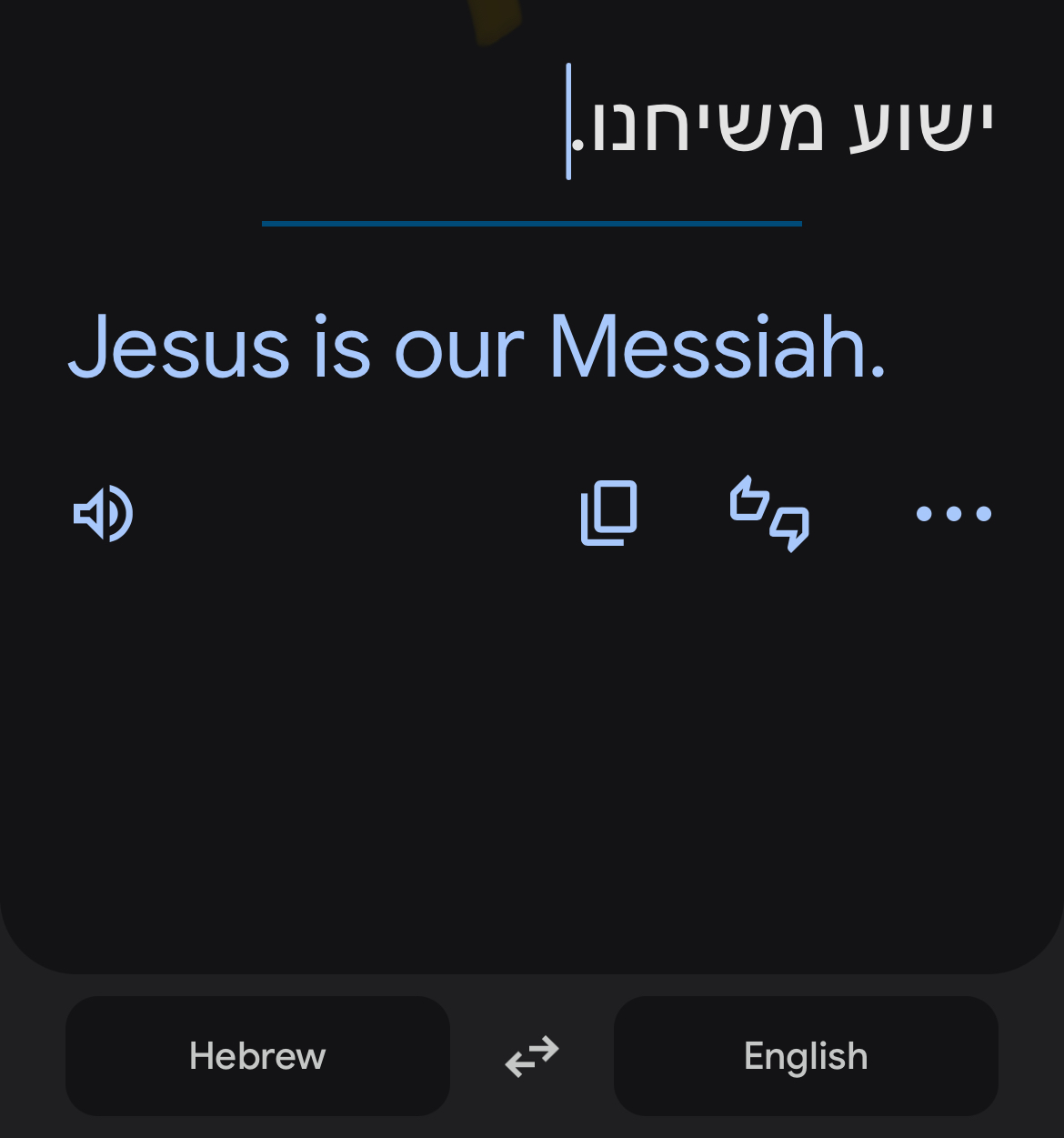
A search for the phrase Yeshua Meschihenu (“Jesus is our messiah”) as one continuous text-string in the Thenach Standard Text within an ELS range of 1-150,000 yields 1 positive hit–indicating that it is encoded 1 single time in this particular version of the Hebrew Bible. The encoded phrase is found at an ELS of every 19,694 letters, beginning in Jeremiah 27:10 and ending in Psalm 2:05. The following screenshot documents the grid, with the obvious line of topical correspondence highlighted in blue:

Here we can see the encoded phrase “Jesus is our messiah” running vertically down the grid, where it intersects with Psalm 2:6-7. While the appearance of this 10-letter phrase in a broad ELS search is already statistically improbable, what is remarkable is that this single occurrence aligns precisely with one of the most important Messianic prophecies in the Bible:
- Psalm 2:6-7 – “Yet have I set my king upon my holy hill of Zion. I will declare the decree: the LORD hath said unto me, Thou art my Son; this day have I begotten thee.”
Given the vast number of possible letter placements, the probability of this alignment occurring randomly is estimated at less than 1 in 10⁶¹, making it statistically impossible under natural conditions.
The precision of this encoding is also noteworthy. Note that where the encoded phrase ends (the last letter of Psalm 2:5), the line of topical correspondence begins (the first letter of Psalm 2:6), resulting in the encoded phrase and line of topical correspondence forming a clean right angle on the grid. Such precision is yet another obvious token of the code’s intelligent design.
It should be pointed out that the word meshiach (messiah) is used in the plain text of Psalm 2 in reference to this king and son of God of whom the Psalmist is speaking (Ps. 2:2). It should also be noted that part of the line of topical correspondence in this example was quoted by the author of Hebrews in his defense of Jesus’ messianic identity (Heb 1:5). Taken together, it is painfully obvious that this code did not happen by coincidence. This is yet another example of a long-distance Bible code which testifies of the divine authenticity and letter-for-letter inerrancy of the Masoretic Text generally, and the Thenach Standard text specifically.
Masoretic text #2: The Leningrad Codex
Having now looked at three examples of long-distance Bible codes from the Thenach Standard text which demonstrate the inerrancy of this particular edition of the Masoretic text, we turn our attention now to the Leningrad codex. Dating to the year 1008 AD, the Leningrad codex is our oldest complete manuscript of the entire Hebrew Bible. There are a few different printed editions of the Hebrew Bible which are entirely based on this manuscript—the most prominent being the Biblia Leningradsia Stuttegartensia, and the Westminster Leningrad Codex. All of the Bible codes that I am about to share which are exclusive to the Leningrad Codex can be found in both of these. As we are about to see, the divine authenticity and inerrancy of the Masoretic Text applies is not exclusive to the Thenach Standard text, suggesting that there is more than one divinely sanctioned edition of the Hebrew Scriptures.
Example 1: “The land of America” Bible code
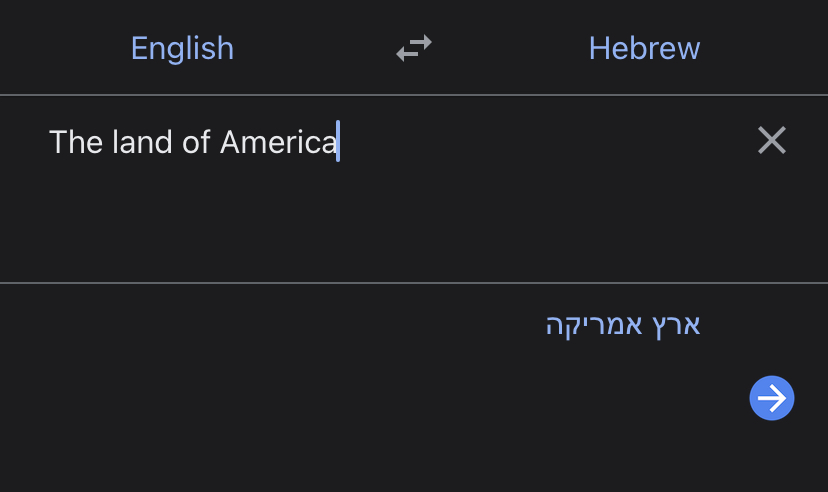
Here is another example that I have written about at greater length in a previous post. A search for the name eretz America (literally: “the land of America”) within an ELS range of 1-150,000 in the Leningrad Codex yields 1 positive result–indicating that this phrase is encoded in this version of the Hebrew Bible 1 single time–being found at an equidistant letter skip sequence of every 48,256 letters beginning in Numbers 14:12. The following screenshot documents what this code looks like on the grid, with the line of topical correspondence highlighted in blue:

While the appearance of this nine-letter string within a broad ELS search is already statistically improbable, what is remarkable is that this single occurrence aligns precisely with a significant biblical statement about the formation of a great nation:
- Numbers 14:12 – “I will make of you a great nation.”
Given the vast number of possible letter placements, the probability of this alignment occurring randomly is estimated at less than 1 in 10⁵⁵, making it statistically impossible under natural conditions–much more than 1 in quadrillions.
This is a particularly astounding code, as the encoded phrase “the land of America” begins with the letter aleph at the beginning of the word aseh, (literally: “I will make”), which in the plain text is part of the larger statement: “I will make of you a great nation.” Thus the encoded phrase “the land of America” converges with this line of plain text on the grid to form a unified prophetic statement about the future United States of America. One does not need to be a mathematician or statistician to recognize that this is simply too precise and perfect to have occurred by random chance. As a reminder, this is the one and only time that the phrase “the land of America” appears encoded in this version of the Bible.
This Bible code constitutes a cryptic prophecy in which the Lord promises thousands of years beforehand to make the United States of America into a great nation–a prophecy which has long since been fulfilled (Isa. 42:9, 45:21, 46:9-10, 48:3-7; John 13:19; 14:29).
This is a fine example of a long-distance Bible code which proves that the Leningrad codex–another “edition” of the Masoretic text, is also inerrant and orthographically perfect down to the very letter, despite containing hundreds if not thousands of minor orthographic deviations from the Thenach Standard text!
Example 2: The “Jesus of Nazareth” Bible code
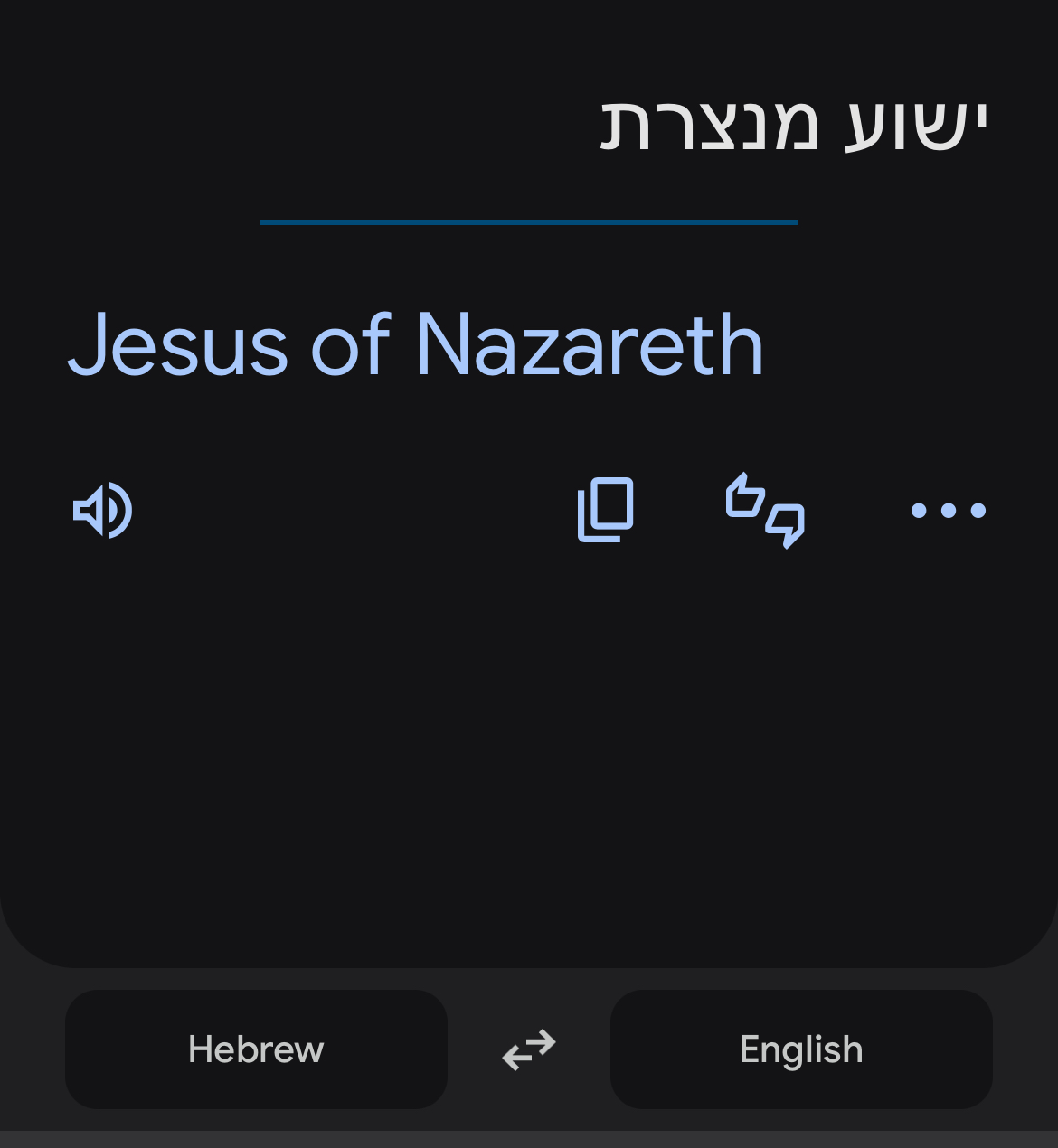
Here is another example of a long-distance Bible code in the Leningrad Codex. A search for the name Yeshua M’netseret (“Jesus of Nazareth”) as one continuous text-string within the ELS range of 1-150,000 in the Leningrad codex yields a total of two positive hits–indicating that this Hebrew phrase is encoded in the Leningrad codex just twice. The screenshot below documents the grid of one of those two positive hits (note that I have highlighted the lines of topical correspondence blue and red in this example):

The encoded phrase ישוע מנצרת (“Jesus of Nazareth”) appears twice within an ELS range of 1-150,000 in the Leningrad Codex, while not appearing at all within the same range in the Thenach Standard Text. This suggests that its occurrence is already relatively rare. However, what is most remarkable is that one of these occurrences aligns perfectly with two thematically relevant statements in the plain text:
- Isaiah 37:16 – “He alone is God.” (cf. Luke 9:36)
- Psalm 134:3 – “He made heaven and earth.” (cf. John 1:3; Eph. 3:9; Col. 1:16)
Given the vast number of possible letter placements, the probability of this alignment occurring randomly is estimated at less than 1 in 10⁵⁵, making it statistically impossible under natural conditions.
The presence of such obvious lines of topical relation occurring on the grid of such an exceedingly-rare encoded phrase strongly suggests that this is not a random chance occurrence. What we appear to have here is another example of a long-distance Bible code which bears witness of the divine authenticity and inerrancy of the Masoretic text generally, and the Leningrad codex specifically.
Example 3: The “Jesus is our king” Bible code
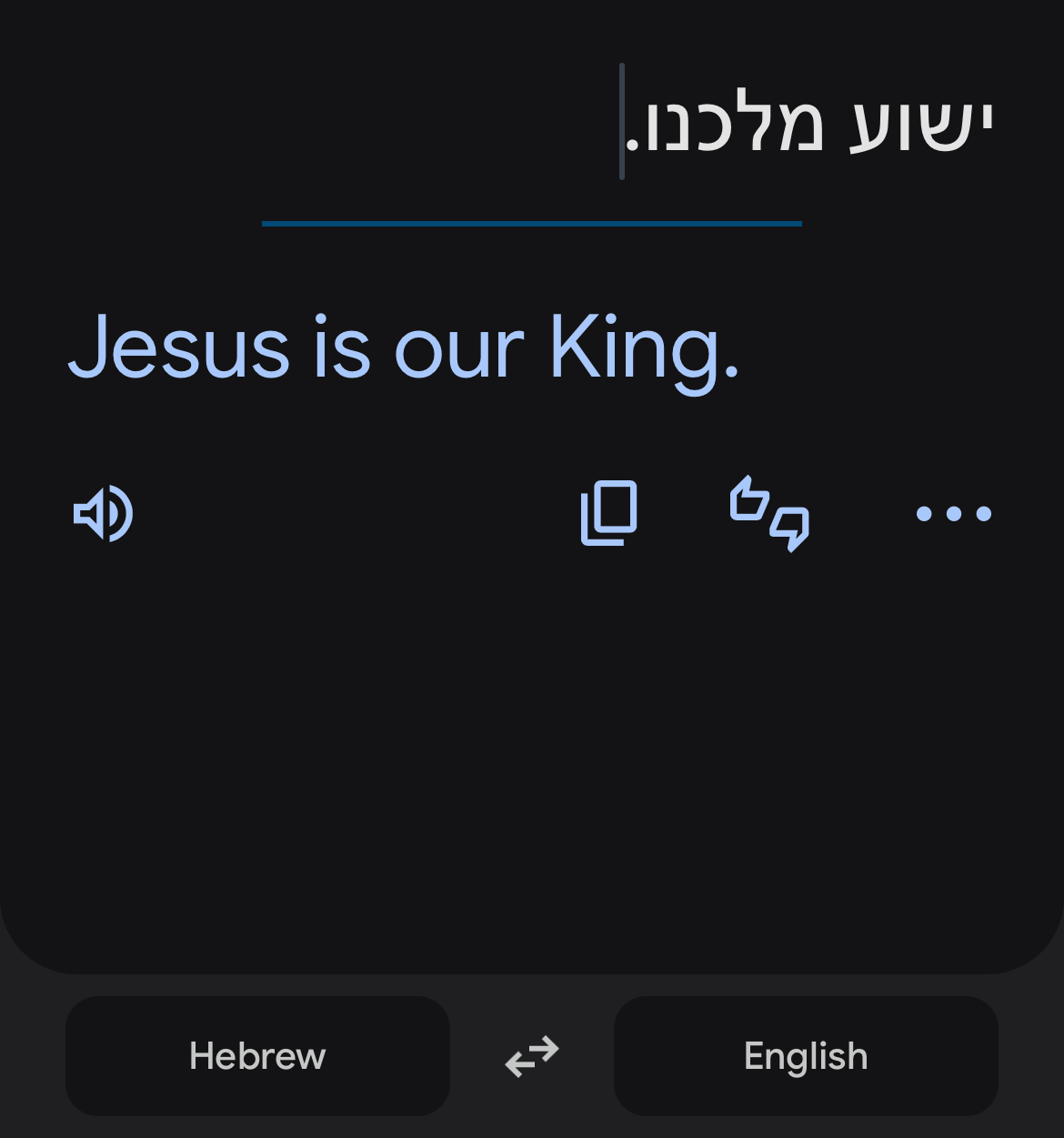
A search for the phrase Yeshua melechnu (“Jesus is our king“) at an ELS of 1-150,000 in the Leningrad codex yields a total of 5 positive hits–indicating that this phrase is encoded 5 times in this particular version of the Hebrew Bible. Of those 5 positive hits, one immediately stands out amongst the others due to the clean convergence of the encoded phrase with its very obvious line of topical correspondence on the grid. Behold:

While the appearance of this nine-letter phrase within such a wide range is not inherently improbable due to the frequency of its letters, what is remarkable is its precise alignment with a topically relevant statement Psalm 47:7 (“Sing praises to our king”), with which it shares the same final letter, resulting in a perfect convergence of the two to form a unified coherent statement and a clean right angle on the grid.
Given the vast number of possible letter placements, the probability of such an alignment occurring randomly in this exact way is estimated at less than 1 in 10⁵⁹, making it statistically impossible under natural conditions.
The perfect merger of the encoded phrase “Jesus is our king” with the topically relevant statement “Sing praises to our king” on the grid to form one unified coherent statement is proof of the code’s divine origin.5 The primary line of topical correspondence gives the commandment to sing praises to Israel’s king, while the encoded phrase reveals who the king is.
This is another great example of a long-distance Bible code which testifies of the letter-for-letter inerrancy of the Masoretic text, and more specifically–the Leningrad codex.
Summary of Probability Estimates
The probability estimates accompanying each of these Bible code examples point to a consistent conclusion: these encodings are not the product of statistical noise. To make the scope of this phenomenon easier to grasp, here is a summary of all six long-distance Bible codes featured in this post, along with their number of ELS occurrences and estimated probabilities of appearing by random chance:
| Bible code | Phrase | ELS Hits | Probability |
| Titanic | טיטאניק | 1 (Thenach Standard Text) | < 1 in 10⁴³ |
| Golgotha | גולגולתא | 3 (Thenach Standard Text) | < 1 in 10⁴⁹ |
| Jesus is our Messiah | ישוע משיחנו | 1 (Thenach Standard Text) | < 1 in 10⁶¹ |
| The land of America | ארץ אמריקה | 1 (Westminster Leningrad Codex) | < 1 in 10⁵⁵ |
| Jesus of Nazareth | ישוע מנצרת | 2 (Westminster Leningrad Codex) | < 1 in 10⁵⁵ |
| Jesus is our King | ישוע מלכנו | 5 (Westminster Leningrad Codex) | < 1 in in 10⁵⁹ |
These probabilities show that the phenomenon is not only consistent across different names and themes—but utterly impossible to attribute to chance.
Conclusion: Bible codes prove the Inerrancy and Divine Authenticity of the Masoretic Text
The presence of long-distance Bible codes overturns the widespread false doctrine that only the original autographs were perfect and without error, and demonstrates both the divine authenticity and inerrancy of the Masoretic text. These intricate patterns, embedded within the Masoretic Text, serve as divine watermarks of authenticity which prove its supernatural preservation and divine inspiration. Far from being a mere textual tradition, the Masoretic Text emerges as the most superior and inerrant form of the Hebrew Scriptures.
Even more remarkably, these codes reveal that multiple manuscripts and editions of the Masoretic Text each bear their own unique network of divine watermarks (long-distance Bible codes), which are created by the totality of the minor orthographic variations contained within each particular manuscript or text-form. This reveals that these minor orthographic variations that we find in different manuscripts and editions of the Masoretic text are not human errors at all, but rather are meticulous deviations which were put there deliberately under the watchful eye of divine providence for a higher purpose. This not only proves the divine authenticity and inerrancy of the Masoretic text, but additionally reveals that there appears to be more than one divinely sanctioned edition of the Masoretic Text.
If such patterns are embedded within the very fabric of Scripture, what else might the sacred text reveal to those who seek its hidden wisdom? The presence of Bible codes is not just a testament to textual integrity and the inerrancy of the Masoretic text—it is an invitation to explore the deeper mysteries of God’s word.
© 2025, Zerubbabel. All rights reserved.
- There are two systems for representing vowels in biblical Hebrew. One involves the use of a system of vowel markers developed by the Masoretic scribes who transmitted the text during the Middle Ages. However, there is an alternative method for representing “ee,” “o,” and “u” vowels, which involves the addition of a consonant yod or vav to represent these sounds. The issue is that the scribes who produced the various manuscripts which underlie the Hebrew Bible did not always agree whether certain words in the text should use the vowel markers or consonants to represent a particular vowel, which inevitably resulted in some minor orthographic variation in our manuscripts (and subsequently, the printed editions based on them).
- Being merely willing vessels of the Holy Spirit, the scribes responsible for adding such “watermarks” to the Bible were not even aware of them. I can attest from personal experience that when someone is operating under the inspiration of the Holy Spirit, they are often completely unaware of what God is accomplishing through them.
- I am currently searching for long-distance Bible codes in the Keter Jerusalem edition in attempts to confirm its inerrancy. My early findings are promising, although I haven’t yet found anything compelling enough yet to assert anything with absolute certainty.
- Imagine that NASA sent a lander to Europa, drilled down into its crust of water ice, and discovered a subterranean ocean teeming with all kinds of sea life. Would we then assume that life is most likely something that is unique to Earth and Europa exclusively, or would we naturally assume that there are likely many other worlds containing life in the vast expanse of the Universe?
- Note that I have also highlighted what I believe to be a secondary line of topical correspondence (“and the God of our salvation“) in teal on the line below.

your proof is i am not a robot doesn’t work. I tried to send a message. I need help to know where the codes are located.
look at http://www.whycodes.com video documentary on the codes
av*********@***il.com
514-291-3061
I live in canada