Introduction
In a previous article, I demonstrated how the golden candlestick that God instructed Moses to make for the tabernacle in the book of Exodus is a symbol of the completed Holy Bible. I explained how this is evident from the biblical description of its design–one unified candlestick, ornamented with exactly 66 knops, almonds, and flowers across its seven arms–sectionally divided into 39 and 27, mirroring the 39 books of the Protestant Old Testament and the 27 books of the New Testament. It really doesn’t get much more obvious than that! In this post, I want to share a Bible code I discovered which further reinforces the truth of this beautiful mystery, affirming that the Bible is a bright light. And what more appropriate book of the Bible could we have asked to find this code in than Micah—the only book with seven chapters, perfectly matching the seven arms of the golden candlestick?
The Golden Candlestick as a Symbol of the Bible
The golden candlestick is more than just an artifact of the Tabernacle—it is a meticulously crafted symbol of the completed Holy Bible, woven into Scripture long before the Bible itself was finalized. This is not my own subjective interpretation, but an inferable conclusion based on the biblical description of the candlestick’s design.
As previously stated, the golden candlestick was ornamented with exactly 66 knops, almonds, and flowers. But it doesn’t stop there. As I explained in a previous article which expounds this mystery in much greater detail, Genesis 1 as well as Revelation 2-3 both testify that the golden candlestick was patterned according to a meticulous 4-3 divisional schema, revealing that the first three branches plus the central shaft constitute one section, while the latter three branches constitute the other section. 1
I showed how when this implied divisional schema is imported and applied to the golden candlestick as described in Exodus 25:31-40, it reveals that the 66 ornaments on the golden candlestick were divided into 39-27, as the first three branches plus the central shaft contained a total of 39 ornaments, while the remaining three branches contained a total of 27 ornaments. This perfectly reflects the design and divisional schema of the completed Holy Bible as exemplified in the Protestant biblical canon–which consists of 66 books, divided into two testaments–with 39 books in the Old Testament, and 27 books in the New Testament.
Based on these observations, it is literally undeniable that the golden candlestick obviously functions as a meticulously designed symbol of the completed Holy Bible–which God (in his perfect foreknowledge) knew thousands of years in advance would contain a total of 66 books–divided into two testaments of 39 (OT) and 27 books (NT). I have created the following image which makes this mystery plain:

Each of the six branches contained a total of 9 knops, almonds, and flowers–while the central shaft contained 12.
9 x 3 + 12 = 39 ornaments (central shaft + three branches)
9 x 3 = 27 ornaments (remaining three branches)
Again, this perfectly reflects the design of the completed Holy Bible–which has 66 books, divided into two testaments–with 39 books in the Old, and 27 books in the New.
Even the very word for ‘branch’ in Exodus—qaneh—is deeply significant. This word is the root of ‘canon,’ the term used for the official books of Scripture. This means that, quite literally, the branches of the golden candlestick symbolize the structure of the biblical canon itself!
When we think about it–the typology makes logical sense. The Bible says: “Thy word is a lamp unto my feet, and a light unto my path” (Psalm 119:89). In addition, Zechariah 4 also states plainly that the golden candlestick is a symbol of the Word of God (Zech 4:6).
But of course, you can never have too many witnesses when establishing biblical truths. The golden candlestick alone is an undeniable testimony, but what if God embedded another layer of confirmation—hidden in the very text of Scripture? As we are about to see, the truth of this mystery is even further reinforced by an ELS Bible code that I discovered recently, which I am going to share with you now.
Hidden Bible code in Micah 7 declares that the Bible is a bright light
The Bible code I am about to reveal is what I refer to as a Commentarial ELS code, or Type 2 ELS code. I refer to codes of this type as “Commentarial” because they essentially function as a form of divine commentary on the containing biblical passage.
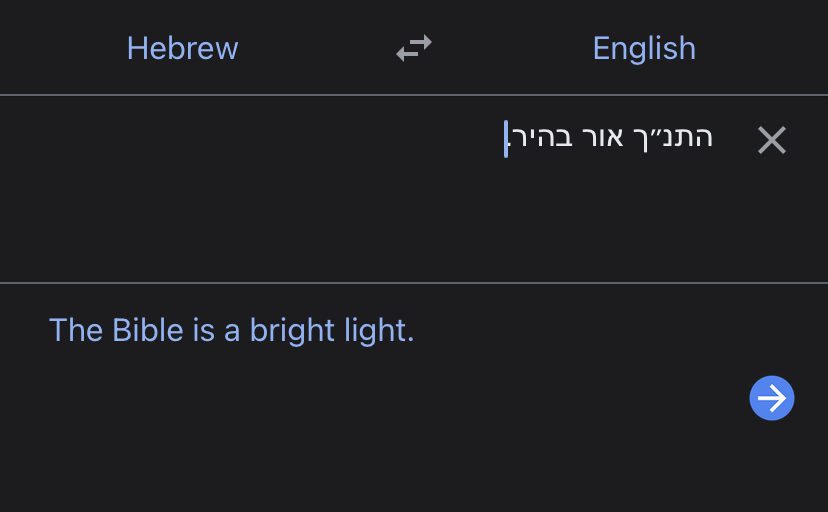
The string that I initially ran the search for when I uncovered this Bible code was the phrase ha-tanakh orr (התנך אור), which translates to English as: “The Bible is a light.” The search was run with the ELS range set to 1-150, meaning that the computer searched for the specified phrase only at equidistant letter sequences <=150. This means that the software starts at the first letter of the Bible, and searches for the specified phrase at every possible equidistant letter sequence between 1 and 150 beginning from that letter. It then repeats this process beginning at the second letter. Then the third letter, and so on and so forth. The entire process is repeated until the computer has looked for the specified string at all ELS’s within the specified range beginning from every single letter of the Bible. This entire process is carried out in a matter of milliseconds.
Conducting the search within such a small window of potential skip sequences drastically reduces the likelihood of the specified string being found encoded anywhere in the Bible.
So I ran the search with the 150-letter maximum skip constraint, and the software returned a total of two hits in the result set–indicating that the specified seven-letter phrase was encoded only two times in the Hebrew Bible within the specified ELS range. One positive hit was in Genesis 50:15-20, where the specified string is found encoded at an ELS of every 36 letters, while the other hit was in Micah 7:4-10 at an ELS of every 50 letters. It was the latter of these which immediately grabbed my attention.
The first thing that I immediately noticed about the Micah encoding, was that the specified phrase was encoded in a thematically relevant passage–right next to two verses which speak of the LORD being a light. So right away I was fairly certain that this was not a random chance occurrence. This suspicion was immediately confirmed by the next thing that caught my eye.
As I was analyzing the grid, I suddenly realized that if you keep going straight down the grid where the encoded string ends, the next four letters on the next four lines of text are: beyt, hey, yod, resh–which spell out the word בהיר (meaning: “bright”). This observation led to the relatively immediate realization that the encoded phrase I had searched for and found encoded here in Micah 7, was actually part of a larger deliberately encoded statement, namely: “The Bible is a bright light.” Now I knew with 100% certainty that this was an authentic, divinely encoded Bible code.
The addition of this four letter word meant that the entire encoded string in this example was actually 11 total letters in length. This is exceptionally long for a Bible code encoded at any distance–let alone a short-distance of only 50 letter skips!2
The following screenshot reveals what the entire encoded string looks like on the grid, with the lines of topically relevant plain text highlighted. Behold:

Exclusivity of the Code
As the above Bible code grid reveals, the Hebrew statement ha-tanakh orr b’hir (English: “the Bible is a bright light”) is encrypted in Micah 7:4-15 at an ELS of every 50 letters, beginning at the letter hey in the word באה in verse 4.
Given the length of the encoded string in this example, it should not be surprising to learn that this is the only passage in the entire Hebrew Tanakh where this eleven-letter string is encrypted within the narrow ELS range at which the search was conducted. In fact, finding any specific 11-letter phrase at an equidistant sequence under 150 skips is already statistically improbable. But for it to appear in a thematically relevant passage about God being a light makes this discovery truly extraordinary. Yet, it turned out to be even better than I initially realized.
Just for kicks, I decided to go back and run the same search again, except for this time–I changed the maximum letter skip in the specified ELS range from 150 to 150,000, thereby telling the computer to look for this phrase at every possible ELS between 1 to 150,000. This greatly increases the likelihood of finding the string encoded in other places. Yet even with this exceedingly large maximum skip constraint, this was still the only place in the entire Hebrew Bible where this 11-letter string appeared.
This exclusivity—the fact that this statement appears encoded here and nowhere else—is only half of the equation. To put this in perspective, a random 11-letter phrase could theoretically be found elsewhere at extreme letter skips.3 But for such a phrase to appear only once in the entire Hebrew Bible, and to appear at such a short-distance ELS, and in a passage directly describing God as a light, defies statistical probability. It is not just that the encryption itself is exceedingly rare, but also the topical and thematic relevance of the passage where it appears.
What are the chances that, the one single time that this statement is found encoded in the Bible, it would just so happen to occur in a thematically relevant biblical passage?
To find the coherent statement “The Bible is a bright light,” encoded exclusively within a biblical passage that just so happens to be talking about the LORD being a light–screams deliberate intelligent design. This is no chance occurrence. It is the fingerprint of the Almighty.
Conclusion: Bible code affirms that the Bible is a Bright Light.
The assertion that the Bible is a bright light is a powerful statement that is supported by the Bible itself, being reinforced by the aforementioned mystery of the golden candlestick that I have already revealed at length in another article. It is further supported by the words of the Psalmist, who wrote: “Thy word is a lamp unto my feet, and a light unto my path” (Ps. 119:105). It is reinforced even further by the fact that the Hebrew phrase דבר־יהיה (“the word of the LORD“) is alphanumerically equivalent with God’s first words in Genesis 1: יהי אור (“Let there be light“),4 All of these biblical truths harmonize beautifully with the assertion of the Micah 7 Bible code that the Bible is a bright light.
The Bible is indeed the bright light that never goes out (Lev. 24:2); it lights our path (Ps. 119:105), exposes our sin (Rom. 3:20), and reveals to us the way of salvation (John 5:39; cf. 14:6). And just as the golden candlestick burned continually in the Tabernacle, so too does the light of God’s Word shine forever, illuminating the hearts of all who seek the truth. The evidence is undeniable. From the structure of the Menorah to the hidden message in Micah, God has left His signature for those with eyes to see. The Bible is a bright light—because it was designed to be.
© 2022 – 2025, Zerubbabel. All rights reserved.
 Copyright secured by Digiprove © 2022 Zerubbabel
- The teachers in this video explain how this divisional schema is evident in Revelation chapters 2 and 3.
- For reference, it is rare to find any particular 11 letter string encoded anywhere in the Bible at any distance–even when the ELS range search range is set to 1-150,000. Needless to say, it is almost unheard of to find an 11-letter string encoded within the range of 1-150.
- It is still fairly rare to find 11-letter phrases even at very large letter skips.
- Both of these phrases add up to 232 when all of their containing Hebrew letters are summed, reinforcing the prophetic link between the word of God and light.